Outdoor Christmas Lights
How long do permanent Christmas lights last?
The LEDs are rated for decades of seasonal use. Nothing else on the system is, and that gap is what the warranty terms are really about.
Mike M. — The hands-on owner behind Iron Mako Media.
Published
This page contains affiliate links. If you buy through them we may earn a commission at no cost to you, and it never decides what we recommend. How this site is funded.
The direct answer: the LEDs in a permanent lighting system are published at around 50,000 hours of rated life across almost the whole market — Trimlight, Gemstone, EverLights, Govee and Celebright all state about 50,000 hours, and Oelo publishes a 100,000-hour usage rating. At 6 hours a night for a 60-night Christmas season, 50,000 hours is 139 seasons. Run the same system as year-round accent lighting at 6 hours every night and it is about 23 years. Neither of those is the number that matters, because the LEDs are not what fails. The controller, the power supply, the adhesive and the connectors are, and the published warranty terms — 1 to 10 years, or lifetime with conditions — are the honest estimate of how long the whole system lasts.
What a 50,000-hour rating means
An LED rated life is not a time-to-failure figure. It is the point at which the diode is expected to have dimmed to a stated fraction of its original output — typically 70 percent — while still working. So a 50,000-hour system does not go dark at 50,000 hours; it gets gradually dimmer and shifts slightly in color over that span, and you would struggle to notice either on your own house because the change is slow and uniform.
What that means in practice depends entirely on how many hours a year you actually run it, and that is the calculation nobody does before buying.
| How you use it | Hours per year | Years to 50,000 hours |
|---|---|---|
| Christmas only, 6 h a night, 60 nights | 360 | 139 |
| Every major holiday, 6 h a night, 120 nights | 720 | 69 |
| Year-round accent, 6 h every night | 2,190 | 23 |
| Year-round, dusk to dawn, 12 h every night | 4,380 | 11 |
The useful conclusion from that table is not that the lights last forever. It is that the LEDs will outlive everything else in every one of those rows, including the one at the bottom. So the real question is what breaks first.
The four things that fail before the LEDs
- The control box and power supply. These contain electronics, and they are rated lower than the strand itself on every system that publishes separate figures. Govee publishes IP68 for the 2 Pro strand and Y connector but IP67 for the control box and adapter. Lumary publishes IP67 for the lights and adapter and IP65 for the control box. The lowest number on the spec sheet is the part that will need replacing.
- The mounting. DIY kits mount on an adhesive track, often with nails and cable buckles supplied as backup — Lumary ships a 3M adhesive base with both. Adhesive on an exterior surface through freeze-thaw cycles and summer heat is the component with the shortest realistic life on a DIY install, and it is the main structural difference from a dealer-installed aluminum channel.
- The connectors and splices. Every cut, extension and reconnection is a joint. Govee rates the Y connector to IP68 alongside the strand, which is the right way to specify it; a splice you make yourself on site is only as good as the work.
- The app and the cloud service. A system controlled through a manufacturer app depends on that manufacturer continuing to support it. There is no published figure for this and there cannot be, but it is a genuine failure mode for connected hardware and it is worth weighing against a system with a physical control box.
Operating temperature is the specification to check
A system's real lifespan on your house is decided mostly by the weather it sits in, and almost nobody publishes a figure for it. Lumary does: -4 F to 140 F on the Permanent Outdoor Lights Max. That range covers most of the continental United States and it is a meaningful commitment, because the electronics in the control box are the part that cold and heat cycling degrade.
Ingress rating is the other half. IP68 on a strand means it is specified against sustained water immersion, not just rain, which is the right rating for something that sits in a gutter line full of melting snow for three months. IP65 on a control box is rated against water jets but not immersion, which is why a control box should be mounted somewhere that never pools.
How this compares to a C9 string on clips
A seasonal C9 LED string is the honest benchmark, and it does better on this specific question than people expect. Wintergreen publishes a 60,000-hour rated life on the OptiCore line — a higher figure than most permanent systems — with a polycarbonate lens the manufacturer states has 200 times the impact strength of glass. It also spends nine months of the year in a box in your garage rather than on the roof, which is the single biggest life-extending factor available.
That is the trade in one sentence: a permanent system buys you convenience and eleven other months of use, and pays for it with continuous exposure to weather. A seasonal string buys you a longer component life and lower cost, and pays for it with a weekend every November. Are permanent Christmas lights worth it works through the money side of the same decision, and can you leave Christmas lights up all year explains why you cannot simply leave a seasonal string up to get the same convenience.
Making a permanent system last
- Mount the control box where water never pools and where you can reach it. It is the lowest-rated component and the one you are most likely to replace.
- Keep the gutter clear. A strand sitting in a blocked gutter full of standing ice is being tested well past what any IP rating assumes about drainage.
- Register the warranty immediately. Gemstone's lifetime term requires registration inside 30 days. A warranty you forgot to activate is not a warranty.
- Do not run it dusk to dawn all year out of habit. The bottom row of the table above is the only usage pattern where the LEDs themselves become the limiting component, and it buys you nothing after the household is asleep.
- Keep the original install photos and part numbers. Replacing one section of a cut-and-reconnected run years later requires knowing exactly which generation you have.
What to buy
The products that fit the advice above, chosen by the process on our methodology page. Every specification quoted is the manufacturer’s own published figure, linked on the page.
Quick picks
| # | Product | Best for | Score | Price |
|---|---|---|---|---|
| 1 | 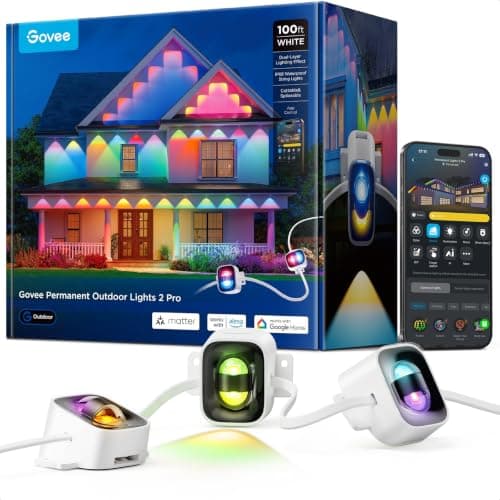 Top pickGovee Permanent Outdoor Lights 2 Pro, 100 ft100 ft / 60 lights, cuttable, IP68 | A permanent track trimmed to a complicated roofline | 8.8 | $499.99 · View on Amazon |
| 2 | 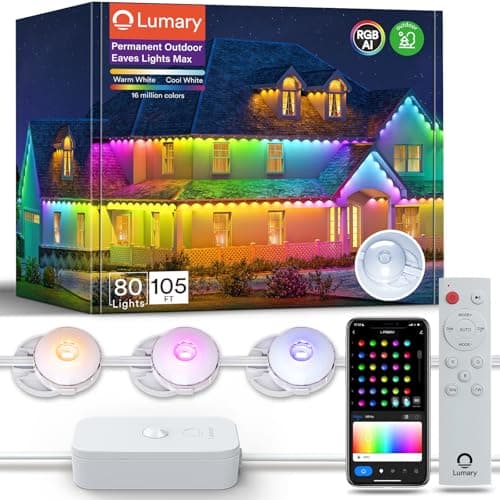 Lumary Permanent Outdoor Lights Max, 105 ft / 80 LED105 ft / 80 LED, RGBAICW, 2200K-6500K | Warm white you can actually tune | 8.7 | $389.99 · View on Amazon |
| 3 | 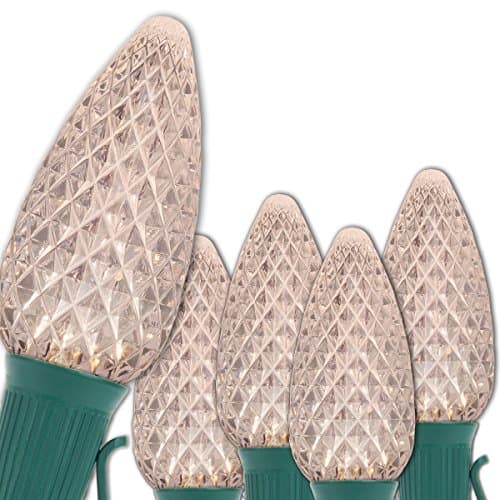 Wintergreen Lighting OptiCore C9 LED, 25 ft25 bulbs / 25 ft, 12 in spacing | Rooflines you want to keep for a decade | 9.2 | $49.99 · View on Amazon |
#ad We may earn a commission · Price as of October 17, 2026
Scores are our own editorial judgment from published specifications and buyer feedback, scored against the same criteria across this category. See how we pick.
Jump to a full review below: lights
Common questions
How long do permanent Christmas lights last?
The LEDs are published at around 50,000 hours of rated life by Trimlight, Gemstone, EverLights, Govee and Celebright, and at 100,000 hours by Oelo. At 6 hours a night for a 60-night Christmas season that is 139 seasons; as year-round accent lighting at 6 hours every night it is about 23 years. The LEDs are not the limiting part, though — the control box, power supply, adhesive mounting and connectors all fail sooner, which is why published warranties run from 1 to 10 years.
Does a 50,000-hour LED rating mean the lights go out at 50,000 hours?
No. A rated life is the point at which the diode is expected to have dimmed to a stated fraction of its original output, typically 70 percent, while still working. The change is slow and uniform across the whole run, so it is very hard to notice on your own house.
What part of a permanent lighting system fails first?
The control box or power supply, followed by the mounting. Every system that publishes separate ingress ratings rates the electronics lower than the strand: Govee publishes IP68 for the 2 Pro strand and IP67 for the control box and adapter, and Lumary publishes IP67 for the lights and IP65 for the control box. On a DIY install the adhesive track is the other short-life component.
Do permanent Christmas lights last longer than regular Christmas lights?
Not by component life. Wintergreen publishes a 60,000-hour rated life on its OptiCore C9 line, which is higher than most permanent systems, and a seasonal string also spends nine months a year in a box rather than on the roof. What a permanent system buys is convenience and year-round use, not longevity.
What temperature range are permanent Christmas lights rated for?
Most brands publish nothing, which is worth noticing. Lumary publishes -4 F to 140 F for the Permanent Outdoor Lights Max. Where no operating range is published, the ingress rating is the only environmental specification you have, and the lowest-rated component in the system is the one that decides its life.
Sources
Every specification quoted on this page comes from the manufacturer’s own published information or a current retail listing, linked below. Where a figure is not published, we say so rather than estimating it.
- Trimlight — best permanent Christmas lights, how to compare brands in 2026 (approximately 50,000-hour LED ratings for Trimlight, Gemstone, EverLights, Govee and Celebright; Oelo 100,000-hour usage rating; published warranty terms by brand)
- Govee — Permanent Outdoor Lights 2 Pro product page (IP68 strand and Y connector, IP67 control box and power adapter, 50,000+ hour LED lifespan, cut and reconnect)
- Best Buy — Lumary 105 ft Smart Permanent Outdoor Eave Lights, RGBAICW (IP67 lights and adapter, IP65 control box, -4 F to 140 F operating range, 3M adhesive track base with nails and cable buckles)
- Wintergreen Lighting — OptiCore C9 LED specifications (60,000-hour rated life, polycarbonate lens stated at 200x the impact strength of glass)
- Trimlight — Trimlight vs Govee comparison (lifetime product warranty rated to 50,000 hours, minimum one-year dealer labor warranty, published Govee term)
- Access Fixtures — LED operating temperature and its effect on fixture life