Outdoor Christmas Lights
The best permanent outdoor Christmas lights
Every system here is a track of addressable LEDs you mount once and leave up. Four published numbers separate them, and price is not one of the four.
Mike M. — The hands-on owner behind Iron Mako Media.
Published
This page contains affiliate links. If you buy through them we may earn a commission at no cost to you, and it never decides what we recommend. How this site is funded.
Quick picks
| # | Product | Best for | Score | Price |
|---|---|---|---|---|
| 1 | 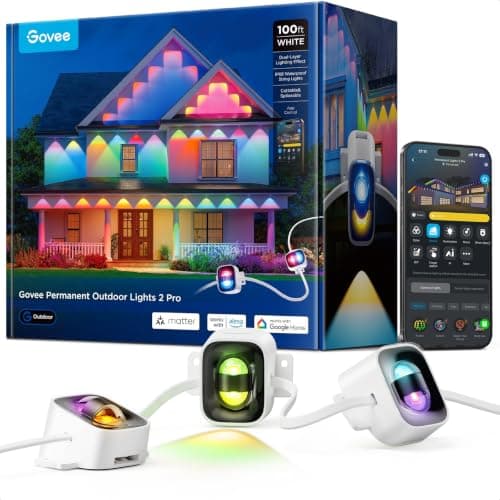 Top pickGovee Permanent Outdoor Lights 2 Pro, 100 ft100 ft / 60 lights, cuttable, IP68 | A permanent track trimmed to a complicated roofline | 8.8 | $399.99 · View on Amazon |
| 2 | 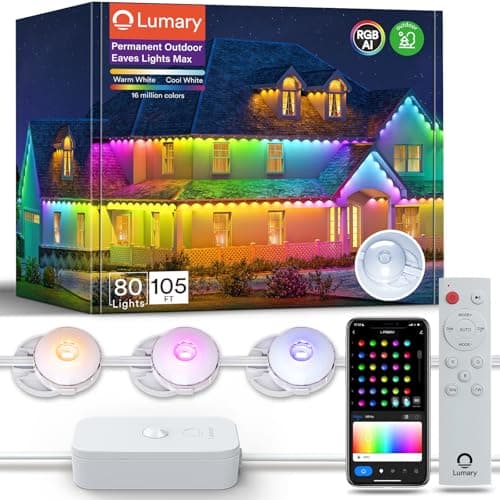 Lumary Permanent Outdoor Lights Max, 105 ft / 80 LED105 ft / 80 LED, RGBAICW, 2200K-6500K | Warm white you can actually tune | 8.7 | $322.99 · View on Amazon |
| 3 | 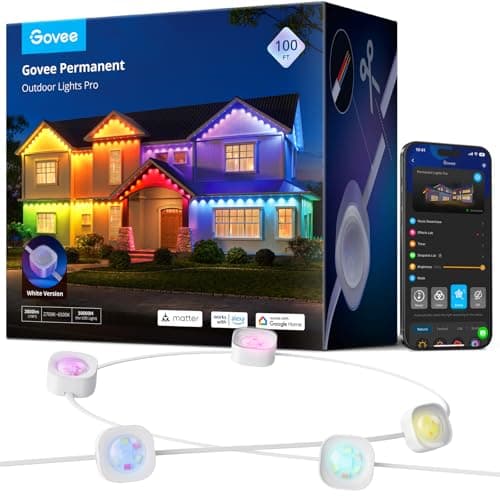 Govee Permanent Outdoor Lights ProRGBIC, app + voice control | DIY year-round eave lighting | 8.6 | $299.99 · View on Amazon |
| 4 | 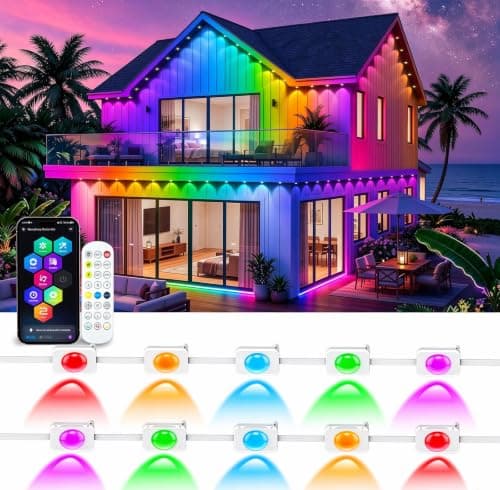 AMURTH 100 ft RGB+IC Permanent Outdoor Lights100 ft, RGB+IC, IP67 | Testing the idea before spending real money | 7.4 | $59.99 · View on Amazon |
| 5 | 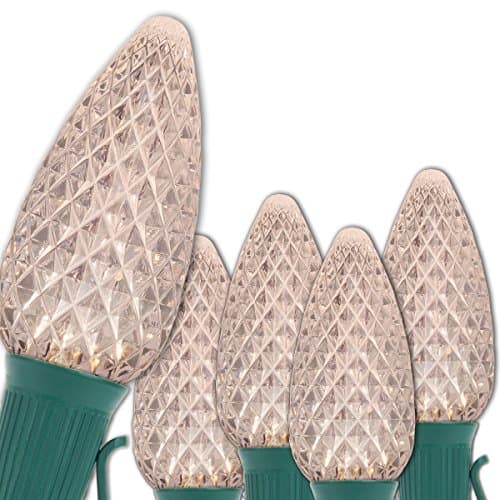 Wintergreen Lighting OptiCore C9 LED, 25 ft25 bulbs / 25 ft, 12 in spacing | Rooflines you want to keep for a decade | 9.2 | $49.99 · View on Amazon |
#ad We may earn a commission · Price as of October 9, 2026
Scores are our own editorial judgment from published specifications and buyer feedback, scored against the same criteria across this category. See how we pick.
Jump to a full review below: lights
The short version: if the run can be cut to your roofline and the strand is sealed to IP68, that is the system to buy, and Govee's 2 Pro is the one that publishes both. If what you care about is the eleven months that are not December, Lumary's tunable 2200K-6500K white is the better specification. Everything else on this page is a price decision.
What permanent lighting is, and who it is for
A permanent system is a track of individually addressable LEDs mounted under the eave and left there year-round. It runs red and green in December, orange in October, and warm white as accent lighting the rest of the year. Nobody buys it for Christmas. People buy it so they never climb a ladder in December again, and that is a completely rational purchase.
The market splits into two halves that barely compete. Dealer-installed systems — Trimlight, JellyFish, Gemstone, EverLights — are fitted by a trained installer, cost several thousand dollars on a typical home, and carry long warranties. Everything on this page is the other half: a kit you buy and mount yourself, at a fraction of that. If you want the dealer comparison rather than the DIY one, start with permanent Christmas lights compared and EverLights vs Trimlight.
The four numbers that actually separate these kits
Every listing in this category reads the same: sixteen million colors, music sync, app control, voice assistants, scene modes. Those features are table stakes and they tell you nothing. These four published figures do.
| Specification | What it tells you | What good looks like |
|---|---|---|
| Ingress rating | Whether the strand and the connectors survive a decade on the fascia | IP67 on the strand, IP68 if you can get it; the control box may sit one step lower |
| Tunable white range | What the house looks like for the eleven months that are not December | A published Kelvin band, e.g. 2200K-6500K; not just 'warm white' |
| Cuttable run | Whether the kit fits your roofline or your roofline has to fit the kit | The manufacturer states the run can be cut, extended and reconnected |
| Published warranty | Who pays if a section fails in year three | A written term you can point at; one year is the DIY norm |
Ingress rating is the first filter
This is the one place where a permanent system is genuinely different from a seasonal light string, because it stays up through every weather event for years rather than six weeks. Govee publishes IP68 on the 2 Pro strand and its Y connector with IP67 on the control box and adapter. Lumary publishes IP67 on the lights and adapter with an IP65 control box. The unbranded tier publishes IP67 on the listing and nothing anywhere else.
- IP65 — protection against water jets from any direction. Fine under an eave with real overhang; marginal on a flush fascia in a wind-driven storm.
- IP67 — sealed against temporary immersion. The sensible minimum for a strand that will be up in five years' time.
- IP68 — sealed against continuous immersion. The highest rating published in DIY permanent lighting, and the difference shows up at the connectors.
- The control box can be lower. It lives somewhere sheltered by design, so a box one rating step below the strand is correct rather than a corner cut.
Are outdoor Christmas lights waterproof covers what these ratings do and do not promise in more detail.
The white light is the specification nobody checks
Here is the thing every review of this category gets wrong. You will run the Christmas scene for roughly six weeks. You will look at the white setting for the other forty-six. If that white is a cold, slightly green mix produced by firing red, green and blue diodes together, the house looks worse lit than unlit, and the system goes unused by March.
That is why a published tunable white band matters more than color count. Lumary's Max uses an RGBAICW five-in-one node with a stated 2200K to 6500K range, which covers everything from candle-warm to daylight. Govee's 2 Pro publishes a 1000K-10000K white range with a dual-layer color effect. A kit that publishes neither is telling you, by omission, that its white is whatever the RGB mix makes.
Cuttable, or the roof has to fit the kit
Permanent lighting has to match the architecture exactly, because you will be looking at it in July. A roofline with gables, returns and a porch is not a single clean length, and a kit sold as a fixed run forces you to loop the excess somewhere or leave a section dark.
Govee states the 2 Pro can be cut, extended and reconnected to fit different eave lengths, with a 200 ft total cap including extensions. The model naming is load-bearing here: Govee's non-Pro permanent models are listed as not supporting cutting. If trimming to length is the reason you are buying, the word Pro in the product name is doing real work. The same logic applies to seasonal lighting — see best trimmable Christmas lights.
The warranty gap, stated plainly
This is where DIY loses and it is worth being honest about it rather than burying it. Govee publishes one year. Lumary does not publish a term as plainly as the dealer brands do. The unbranded kits publish nothing. Against that, Trimlight publishes a lifetime product warranty on core components and EverLights publishes one year labor plus five years parts — both are the companies' own published terms.
If a channel section fails in year three, that difference is the entire product. What you are buying with a dealer-installed system is the install and the warranty, not better LEDs — the diodes are broadly comparable across the whole market. Whether that is worth several thousand dollars is a judgment only you can make, and DIY vs professional install cost runs the arithmetic.
What the DIY install actually involves
- 1
Measure the run before you buy
Walk the eave line with a measuring wheel or a laser and add 10 percent for routing. A 100 ft kit on a 112 ft roofline is a second purchase, and the kits are not always sold in matching lengths.
- 2
Decide where the controller lives
It needs power, shelter and Wi-Fi coverage, and the front eaves of a house are frequently the worst-covered spot on the property. Stand there with a phone before you commit.
- 3
Prepare the fascia
Adhesive-first track wants a clean, sound, dry surface. Chalky paint, dust or a recent repaint means the supplied nails and cable buckles are not optional.
- 4
Set a straight line and keep it
A snapped chalk line or a laser level across the whole run. A track that wanders by half an inch over 40 ft is the thing you will see every day for ten years.
- 5
Route the cable away from water
Drip loops below every connection so water runs away from the joint rather than into it, and nothing lying in a gutter.
If your eaves have no gutter to work from, or the line is high and steep, read hanging lights without gutters before you order — the access problem is the same one, and on some houses it is the reason to pay a dealer.
What nobody tells you before you buy
- It is visible in daylight. Every permanent system is a track under the eave. Color-matched to the fascia it reads as trim. None of them disappear, and any marketing implying otherwise is overselling.
- Restraint is the whole aesthetic. Per-pixel RGB can do a great deal, and a house running a rainbow chase every night in March is the outcome nobody wanted. Most owners settle on one warm white and leave it there.
- The app is a 2.4 GHz device. Several systems are 2.4 GHz only, and a modern combined-band router has to be split or a guest band used for setup. A large share of one-star reviews across this category are that problem rather than a hardware fault.
- It is a weekend, not an afternoon. Mounting, routing, siting the controller and setting up the app is a real project on a ladder. It is not difficult. It is also not quick.
Who should skip this category entirely
If what you actually want is the traditional look — big faceted bulbs outlining the roof — permanent lighting will not give it to you. A pixel track is a line of small nodes, and no scene makes it read as C9. Five seasons of commercial-grade C9 on good clips costs a fraction of one dealer install and keeps the look you wanted, which is why the last pick on this page is a set of lights rather than a system.
How we picked
Published manufacturer specifications only — ingress ratings, Kelvin ranges, cut-and-reconnect capability, lengths, control platforms and warranty terms — plus the live Amazon listing where a kit has no manufacturer documentation, which we say so when it happens. Every figure quoted is linked in the sources below. Scores are editorial judgments, not aggregated user ratings. See methodology.
The picks in full
Top pick
Govee Permanent Outdoor Lights 2 Pro, 100 ft
Govee
The permanent-lighting model explicitly designed to be cut and reconnected, which is what lets it fit a roof with gables and returns instead of forcing the roof to fit the kit.
Permanent lighting and trimmable lighting overlap at exactly one point: a track you mount once has to match the roofline exactly, because you will be looking at it in July. Govee's Pro models are the ones specified for that. Govee describes the 2 Pro as designed to be cut, extended or reconnected to fit different eave lengths and complex rooflines, and sells it as 100 ft and 200 ft kits with a 200 ft total cap once extensions are added.
The model naming is the trap here and it is worth spelling out. Govee's permanent range contains models that are cuttable and models that are not — the Permanent Outdoor Lights 2 is listed as not supporting cutting, while the Pro models are. If trimming to length is the reason you are buying, the word Pro in the product name is doing load-bearing work.
The specification that separates this from an ordinary string is IP68 on the strand, with the Y connector also IP68 and the control box and power adapter at IP67. That is a fully sealed run with a slightly less sealed brain, which is the right way round: the strand sits on the fascia in the weather for years, and the control box can be sited somewhere sheltered.
What you should not expect is invisibility. A permanent track is a visible line under the eave in daylight on every system sold, and any listing photo implying otherwise was taken at night. Color-matched to the fascia it reads as trim, which is the honest best case.
The lengths, LED count, spacing, ingress ratings and the cut-and-reconnect capability above are Govee's published figures, linked in the sources below.
What works
- Cut-and-reconnect is a published capability, not a modification you improvise
- IP68 on the strand is the highest ingress rating in DIY permanent lighting
- One install covers Christmas, Halloween and year-round accent light
- Matter support means it is not locked to a single app forever
What does not
- Costs several seasons' worth of retail C9, and the warranty is short by permanent-lighting standards
- The 200 ft total cap is a real constraint on a large or multi-elevation house
- Non-Pro Govee permanent models do not support cutting — the model name matters
- It is a visible track under the eave in daylight, like every system of this type
| Lengths | 100 ft (H3A51) and 200 ft (H3A53) |
|---|---|
| LEDs | 60 lights on the 100 ft model, roughly 40 cm spacing |
| Ingress rating | IP68 strand and Y connector; IP67 control box and adapter |
| Cuttable | Yes — Govee states the run can be cut, extended and reconnected |
| Max total length | 200 ft (60 m) including extensions, per Govee |
| White range | 1000K-10000K, dual-layer color effect |
| Control | App, 100 preset scenes, Music Sync, Matter, Alexa, Google Assistant |
Warm white you can actually tune
Lumary Permanent Outdoor Lights Max, 105 ft / 80 LED
Lumary
The permanent system with a real tunable white band rather than one fixed white, mounted on a track base the strand slides out of. The two reasons to pick it over Govee are both about the eleven months that are not December.
The thing nobody tells you about permanent eave lighting is that the Christmas setting barely matters. You will use it for six weeks a year. The setting you will actually live with is whatever the house looks like on a Tuesday in April, and that is a white-light question, not a color one.
This is where Lumary's specification earns its place. The LED is an RGBAICW five-in-one node with a published tunable white band of 2200K to 6500K, which means the off-season setting can be a 2700K warm house light that reads as architectural lighting. Systems built on RGB plus a single fixed white diode give you one white and you either like it or you do not.
The second reason to look at this one is the mounting. Lumary builds the Max on a track base fixed with 3M adhesive plus nails and cable buckles, with the light strand sitting in the base rather than being the base. That is the detail that answers two separate real problems: an HOA that will not allow year-round fixtures, and a homeowner who wants the strand down for a repaint. The channel stays, the lights come out.
Ratings are IP67 on the lights and the adapter with an IP65 control box, and Lumary publishes an operating range of -4 F to 140 F. That is the right shape for this product class — the parts in the weather sealed hardest, the brain one step down and sited somewhere sheltered. Forty-four preset scenes, app control, voice assistants and a physical remote are all published features.
Two honest cautions. The app is 2.4 GHz only, which on a modern combined-band router means splitting the network or using a guest band for setup, and plenty of one-star reviews across this whole category are that problem rather than a hardware fault. And the adhesive-first mounting wants a clean, sound, dry fascia; on chalky old paint the mechanical fixings are not optional.
Lengths, LED count, the white range, the ingress ratings, the temperature range, the scene count and the mounting hardware above are Lumary's published figures, linked in the sources on the pages that use this pick.
What works
- A genuine 2200K-6500K white band, so the off-season setting can be a warm house light rather than a cold one
- The detachable track base means the strand can come off and the channel stays mounted
- IP67 on the lights and the adapter, with the control box one step down at IP65
- Per-node addressable color, so a long eave shows motion rather than flashing in unison
What does not
- 2.4 GHz Wi-Fi only — a 5 GHz-only network has to be split before setup
- The track is adhesive-first; a fascia that is dirty, chalky or freshly painted needs the mechanical fixings
- Lumary does not publish a warranty term as plainly as the dealer-installed brands do
- It is a visible line under the eave in daylight, same as every system of this type
| Length | 105 ft with 80 LEDs (158 ft / 120 LED version also sold) |
|---|---|
| LED | RGBAICW five-in-one per node, individually addressable |
| White range | 2200K-6500K tunable |
| Ingress rating | IP67 lights and adapter; IP65 control box |
| Operating range | -4 F to 140 F (manufacturer figure) |
| Scenes | 44 preset scene modes |
| Control | Lumary app (2.4 GHz Wi-Fi only), voice assistants, remote, control box |
| Mounting | 3M adhesive track base, nails and cable buckles supplied |
DIY year-round eave lighting
Govee Permanent Outdoor Lights Pro
Govee
The DIY end of permanent holiday lighting: RGBIC LEDs in a track you mount once, app-controlled, at a fraction of a professionally installed system. The install is genuinely a weekend, and the warranty is short.
Permanent holiday lighting is a track of addressable LEDs mounted under the eave and left there. It is on for Christmas, and then for Halloween, and then as warm-white accent lighting in March. The reason people buy it is not Christmas; it is never climbing a ladder in December again.
The market splits cleanly in two. Professionally installed systems — Trimlight, JellyFish, Gemstone, EverLights and others — are dealer-installed, run several thousand dollars on a typical home, and carry long warranties. Govee is the DIY end: you buy the kit, you mount it, and it costs a fraction of that.
What you are actually buying with the professional systems is the install and the warranty, not better LEDs. Trimlight publishes a lifetime product warranty; Govee's is one year. If a channel section fails in year three, the difference between those two positions is the whole product.
Do not buy this expecting it to be invisible. Every permanent system is a visible track under the eave in daylight. The good ones are color-matched to the fascia and read as trim. None of them disappear, and any marketing that implies otherwise is overselling.
The warranty terms and control features above are the manufacturers' published figures, and the comparison page linked from here lays out where each brand's numbers come from.
What works
- A small fraction of the cost of a professionally installed system
- Per-pixel color means Halloween, Christmas and a July 4th scene from one install
- No ladder in December, ever again
What does not
- One-year warranty against systems that offer ten years to lifetime
- You are the installer, so you own the mounting quality and any leak
- It looks like a light track in daylight — that is true of all of these
| Type | Permanent eave-mounted RGBIC LED |
|---|---|
| Control | App, scheduling, music sync, voice assistants; Matter on current models |
| Install | DIY |
| Warranty | 1 year (per Govee's published terms) |
| Use | Outdoor rated |
Testing the idea before spending real money
AMURTH 100 ft RGB+IC Permanent Outdoor Lights
AMURTH
The unbranded sixty-dollar tier of permanent eave lighting: the right ratings on the listing, app and remote control, and no manufacturer behind it to publish a warranty or still be selling the same kit next year.
There is a real argument for buying the cheap one first in this category, and it is not the price. It is that you do not yet know whether you will like looking at a light track under your eave for the next decade. A permanent system is a mounting decision as much as a purchase, and one season on an inexpensive run tells you something no review can.
Search Amazon for permanent outdoor lights and you will find a whole tier of these at roughly a quarter of what Govee and Lumary charge: 100 feet, RGB+IC addressable nodes, IP67 on the listing, app and remote control, scene modes and music sync. AMURTH's is one of several effectively identical kits. We are listing it because it is the one that was in stock at a verifiable price when we checked, not because the brand means anything.
That is the honest case against it, and it is worth stating plainly. There is no manufacturer website, no published specification sheet and no warranty term we could find. The Amazon listing is the entire documentation set. Next season the same kit will very likely be sold under a different five-letter brand name, which means replacement nodes, a matching extension run, or any support at all is a gamble rather than a plan.
What you are buying, concretely, is one season of finding out three things: whether your fascia takes the track cleanly, whether the controller location you chose actually works, and whether you like the look in daylight in July. Those three answers are worth money, and this is the cheapest way to buy them. If the answer is yes to all three, replacing it later with a system that publishes a warranty is a reasonable plan rather than a waste.
If the answer is no, you have learned it for the price of a decent set of C9s. That is the whole pitch, and we would rather make it that way than dress an unbranded kit up as a bargain version of a named one.
The length, LED type, ingress rating and control features above are the specification published on the live Amazon listing, which is linked in the sources. Where a figure is not on that listing, we have said so rather than filling it in.
What works
- A quarter or less of what the named systems cost, for the same basic architecture
- Addressable RGB+IC, so it is not a single-color strand pretending otherwise
- IP67 on the listing, which is the rating this product class needs
- Cheap enough to treat the first season as a trial of the idea itself
What does not
- No manufacturer site, no spec sheet, no published warranty — the listing is all there is
- No tunable white band published, so the eleven-month look is whatever white the RGB mix makes
- These listings rotate: the brand name on the identical kit changes season to season, so spares and support are a gamble
- Nothing to hold anyone to if a run fails in year two
| Length | 100 ft |
|---|---|
| LED | RGB+IC addressable |
| Ingress rating | IP67 (listing specification) |
| Control | App and 2.4 G remote |
| Modes | DIY and preset scene modes |
| Published warranty | None we could find |
| Manufacturer spec page | None — the Amazon listing is the only published specification |
Rooflines you want to keep for a decade
Wintergreen Lighting OptiCore C9 LED, 25 ft
5 mm Wide Angle LED
The commercial-grade C9 most professional installers use, sold in retail quantities. Thick polycarbonate lenses and a green commercial-gauge wire that survives being handled every year.
C9 is the big, faceted, traditional-looking bulb — the one that reads as Christmas lights from the street rather than as a glow. Wintergreen's OptiCore line is the version professional installers buy, and the reason is not brightness. It is that the lens is polycarbonate rather than glass, and the manufacturer rates the bulbs at 60,000 hours. A season is roughly 45 days at eight hours, so about 360 hours. The arithmetic on that rating is generous enough that bulb failure stops being the thing that ends a strand's life; handling damage is.
The practical case for buying commercial-grade C9 is replaceability. Each bulb screws into an E17 socket. When one dies, you replace one bulb for a couple of dollars instead of pulling a 100-light strand off the roof. Over five seasons that is the whole argument, and it is why the same boxes keep appearing on the same houses.
The honest counterpoint: this is expensive per foot, and it is sold in 25 ft sets. A 180 ft roofline is eight boxes plus spare bulbs, which is a real number. If you are lighting one gable over the front door and you are not sure you will do it again next year, a cheaper set is the right call and we would not argue.
One buying note that trips people up — C9 sets and C9 bulbs are sold separately as often as together. Check whether the listing you are on is a complete lit set or a box of replacement bulbs, because the photos look nearly identical.
What works
- Bulbs are replaceable individually — one failure is not a dead strand
- Polycarbonate lens survives being dropped off a ladder
- Same product line pros buy, so spare bulbs stay available year to year
- End-to-end connectable, so long roof runs are one circuit decision
What does not
- Costs several times what a big-box 100-count set costs
- Green wire is visible against white fascia in daylight
- 25 ft per set means a 180 ft roofline is eight boxes
| Bulb | C9, E17 base, LED |
|---|---|
| Set length | 25 ft, 25 bulbs |
| Spacing | 12 in |
| Lens | Polycarbonate (manufacturer states 200x the impact strength of glass) |
| Rated life | 60,000 hours (manufacturer figure) |
| Wire | Green, commercial gauge |
Common questions
What are the best permanent outdoor Christmas lights?
For a DIY install, Govee's Permanent Outdoor Lights 2 Pro publishes the strongest specification: IP68 on the strand and Y connector, and a run the manufacturer states can be cut, extended and reconnected to fit a complicated roofline. If the year-round white light matters more to you than the Christmas scene, Lumary's Max publishes a 2200K-6500K tunable white band, which is the better specification for eleven months of the year.
Are permanent Christmas lights worth it?
If your main objection to Christmas lights is the annual ladder work, yes — that is what you are buying. A DIY kit costs a fraction of a dealer-installed system. What the installed systems buy you is a long warranty and someone else's liability for the mounting, which on a high or steep eave line is worth real money.
Can you install permanent holiday lights yourself?
The DIY kits are designed for it and it is a weekend job: mounting the track in a straight line on a clean fascia, routing the cable with drip loops, and siting the controller near power and Wi-Fi. The limiting factor is not skill, it is whether your eave line is safely reachable from a ladder throughout.
Can you see permanent Christmas lights during the day?
Yes. Every system is a visible track under the eave. Better installations use channel color-matched to the fascia so it reads as trim, but none of them are invisible in daylight. Any listing photo suggesting otherwise was taken at night.
What IP rating do permanent outdoor lights need?
IP67 on the strand is the sensible minimum for something that stays up for years, and IP68 is better. IP65 — protection against water jets — is adequate under an eave with real overhang and marginal on a flush fascia. The control box can reasonably sit one rating step lower than the strand, because it is sited somewhere sheltered by design.
How much do permanent Christmas lights cost?
The DIY kits span a wide range: the unbranded 100 ft kits are the cheapest route in, the named systems from Govee and Lumary cost several times that, and dealer-installed systems run into several thousand dollars on a typical home. Because prices move constantly, every price on this page is pulled live from the retailer rather than quoted in the text.
Sources
Every specification quoted on this page comes from the manufacturer’s own published information or a current retail listing, linked below. Where a figure is not published, we say so rather than estimating it.
- Govee — Permanent Outdoor Lights 2 Pro product page (IP68 strand, cut-and-reconnect, 200 ft cap, white range)
- Govee — permanent outdoor lights range, showing Matter support and IP67 / IP68 ratings
- Lumary — Permanent Outdoor Lights Pro / Max specification (RGBAICW, 2200K-6500K, IP67 lights, IP65 control box, -4 F to 140 F)
- Amazon — AMURTH 100 ft RGB+IC permanent outdoor lights listing, the only published specification for this kit
- Trimlight — published lifetime product warranty on core components, professionally installed only
- EverLights — published 1 year labor / 5 year parts warranty and ClickLights DIY kits