Takedown & Storage
Can you leave Christmas lights up all year?
Physically yes. But seasonal light sets are specified, listed and warrantied as temporary installations, and the sun is what collects on the difference.
Mike M. — The hands-on owner behind Iron Mako Media.
Published
This page contains affiliate links. If you buy through them we may earn a commission at no cost to you, and it never decides what we recommend. How this site is funded.
The direct answer: no, not with ordinary seasonal light sets — and the reason is written into the standards they are built to rather than into anybody's opinion. UL 588, the standard that covers seasonal and decorative lighting products, defines temporary use as a period of installation and use not exceeding 90 days. The National Electrical Code says the same thing from the other direction: Article 590.3(B) permits temporary electric power and lighting installations for a period not to exceed 90 days for holiday decorative lighting. Leave a set up beyond that and you are outside what it was listed, specified and warrantied for, and the sun is what makes the difference visible — UV breaks down wire insulation, and cracked insulation on a 120-volt outdoor circuit is not a cosmetic problem. If you want lights on the house all year, the product for that exists and it is a different product.
The 90-day rule, and where it comes from
This is the part most people have never been told, and it reframes the whole question. A string of seasonal Christmas lights is not a light fixture. It is a listed temporary-use product, and the listing has a duration in it.
| Source | What it states |
|---|---|
| UL 588 | Covers temporary-use seasonal decorative lighting; temporary use is a period of installation and use not exceeding 90 days |
| UL 588, Supplement SD | Separately covers parallel-connected string lights intended for year-round use — a different category |
| NEC Article 590.3(B) | Temporary installations permitted for a period not to exceed 90 days for holiday decorative lighting and similar purposes |
| NEC Article 410.160 | Decorative lighting used for holiday lighting shall be listed |
The important detail in that table is Supplement SD. The standard does recognise string lights intended for year-round use — they are simply a separate category, evaluated differently. Which means the answer to "can I leave lights up all year" is really "not these ones," and the follow-up question is what the right product is.
What actually happens over a summer
The failure is not dramatic and it is not immediate, which is why the practice persists. It is the wire, and the agent is sunlight.
- UV degrades the insulation. Utility safety guidance is direct about it: the sun's UV rays and temperature changes increase wear and tear on the wire insulation of light sets. The plastic loses flexibility and eventually cracks.
- Cracked insulation lets water to the conductor. From the ground a strand can look perfectly fine while being brittle enough to crumble when handled. That is the dangerous state, because nothing tells you it has happened.
- Freeze-thaw and heat cycling loosen the sockets. On a replaceable-bulb set, a year of expansion and contraction is what starts the corrosion in the socket that kills a section.
- The fixings fail before the lights do. Adhesive hooks and plastic clips are also UV-exposed, and a plastic clip that has sat through July is brittle. A strand coming loose in a wind is how a run ends up hanging across a window.
Utility and safety guidance puts the practical outcome plainly: leaving decorations up too long leads to worn insulation and broken bulbs, creating fire and shock risk that the display did not have in December. The Electrical Safety Foundation International's recommendation is to remove holiday decorations in the first week of January.
What the warranties say about it
You do not have to take the standard's word for it, because manufacturers price the same assumption into their cover. Commercial-grade decorations state their terms on a seasonal basis explicitly: the Red Sleigh commercial pre-lit wreaths publish a 10-year greenery and 3-year lights warranty that is stated on the basis of 90-day seasonal use. That is the manufacturer telling you, in the warranty, how long a year it expects the product to work.
Permanent lighting systems do the opposite — they publish terms for continuous installation, which is the whole point of them. Govee publishes 3 years on its current permanent outdoor products, JellyFish publishes 5 years parts and 1 year labor, and Trimlight publishes a lifetime product warranty based on estimated component lifespan. None of those terms exist on a seasonal light string, because a seasonal light string is not expected to be up.
The product that is meant to stay up
If what you want is a lit roofline available in October, July and any ordinary Tuesday, the honest answer is a permanent lighting system rather than a seasonal string you leave in place. A permanent track is designed for continuous exposure: the strands are rated against sustained water ingress rather than rain, and the better systems publish an operating temperature range as well.
That is a real purchase and not a small one, so it deserves the comparison rather than the shortcut. The best permanent holiday lights covers the systems judged on year-round use rather than on Christmas, how long permanent Christmas lights last covers what actually wears out, and are permanent Christmas lights worth it works through the money.
The middle ground, if you cannot face the ladder
There is one legitimate compromise, and it is about where the lights are rather than how long they stay. The parts of a display that are genuinely hard to reach — a second-storey gable, a high gutter return — are the parts people leave up, and the parts most exposed to sun. The parts that are easy to reach are the ones you can take down in twenty minutes.
- Take down everything within reach in the first week of January, which is where the safety guidance points anyway.
- Leave the clips, not the lights. Plastic clips cost almost nothing and will survive a year better than a strand will. Next November the mounting is already done.
- Replace the genuinely unreachable runs with a permanent track once, rather than leaving a seasonal set on them indefinitely. One high gable on a permanent system is a much smaller project than a whole house.
- Store what you take down properly. A reel or a purpose-made bag is the difference between a set that lasts five seasons and one that lasts two — the best storage bags and bins and the best storage reels cover both.
And if the question behind the question is simply when the display has to come down, the timing — tradition, weather windows and the practical cutoff — is in when to take down Christmas lights.
What to buy
The products that fit the advice above, chosen by the process on our methodology page. Every specification quoted is the manufacturer’s own published figure, linked on the page.
Quick picks
| # | Product | Best for | Score | Price |
|---|---|---|---|---|
| 1 | 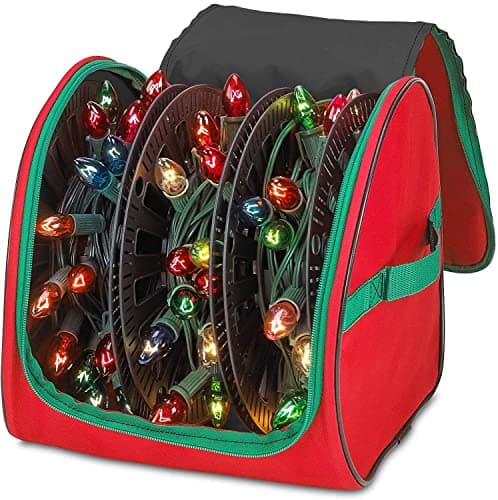 Top pickHOLDN' STORAGE Premium Christmas Light Storage Bag with 3 reels600D + PVC, 3 reels, up to 375 ft | One bag for the whole display | 9.0 | $45.99 · View on Amazon |
| 2 | 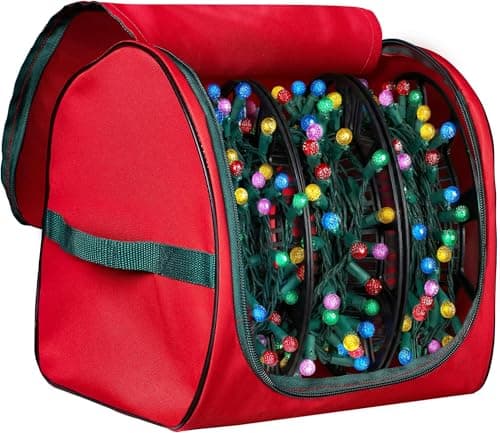 ZOBER Christmas Light Storage Reels, 3 reels with bag3 reels, 600D Oxford bag | Metal reels that will not crack | 8.6 | $36.99 · View on Amazon |
| 3 | 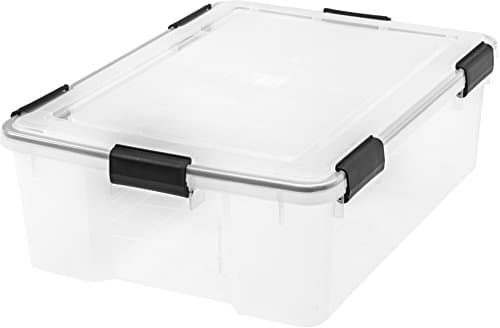 IRIS USA WeatherPro 41 Quart Storage Box41 qt, gasket seal, latching buckles | Clips, stakes, timers and spares | 8.3 | $27.48 · View on Amazon |
#ad We may earn a commission · Price as of October 17, 2026
Scores are our own editorial judgment from published specifications and buyer feedback, scored against the same criteria across this category. See how we pick.
Jump to a full review below: storage-and-takedown
Common questions
Can you leave Christmas lights up all year?
Not ordinary seasonal sets. UL 588, the standard that covers seasonal decorative lighting, defines temporary use as a period of installation and use not exceeding 90 days, and NEC Article 590.3(B) permits holiday decorative lighting installations for a period not to exceed 90 days. Beyond that you are outside what the product was listed and warrantied for, and UV degradation of the wire insulation is what collects the bill.
What happens if you leave Christmas lights outside all year?
The wire fails before the bulbs do. UV rays and temperature changes increase wear on the insulation, which stiffens and eventually cracks, letting water reach the conductor on a 120-volt circuit. A strand can look completely fine from the ground while being brittle enough to crumble when handled, which is the dangerous state because nothing warns you.
Is it against code to leave Christmas lights up all year?
The National Electrical Code treats holiday decorative lighting as a temporary installation and Article 590.3(B) permits it for a period not to exceed 90 days. UL 588 defines temporary use the same way. The standard does recognise string lights intended for year-round use, but as a separate category under Supplement SD — which is to say a different product, not the same one left up longer.
When should Christmas lights come down?
The Electrical Safety Foundation International's recommendation is to remove holiday decorations in the first week of January, and that also keeps you inside the 90-day temporary-use window if you put them up in late November. Taking them down early is the single biggest thing you can do for how many seasons a set lasts.
What lights can you leave up all year?
A permanent lighting system, which is designed for continuous installation rather than a season. Those publish warranty terms on that basis — Govee publishes 3 years on its current permanent outdoor products, JellyFish 5 years parts and 1 year labor, and Trimlight a lifetime product warranty based on estimated component lifespan. A seasonal string has no equivalent term because it is not expected to be up.
Sources
Every specification quoted on this page comes from the manufacturer’s own published information or a current retail listing, linked below. Where a figure is not published, we say so rather than estimating it.
- IAEI Magazine — holiday lighting requirements and the NEC (UL 588 defines temporary use as a period of installation and use not exceeding 90 days; NEC 590.3(B) permits holiday decorative lighting for a period not to exceed 90 days; NEC 410.160 requires decorative holiday lighting to be listed; UL 588 Supplement SD covers parallel-connected string lights intended for year-round use)
- Edison International newsroom — holiday lights still up, take them down now for safety (UV rays and temperature changes increase wear on wire insulation; ESFI recommends removing decorations the first week of January)
- Christmas Lights Etc — Red Sleigh commercial pre-lit wreath (10-year greenery and 3-year lights warranty stated on the basis of 90-day seasonal use)
- Trimlight — best permanent Christmas lights, how to compare brands in 2026 (published warranty terms for systems designed to stay installed year-round)
- NaturaLED — how winter weather affects outdoor LED light fixtures
- ESFI — outdoor decoration safety tips (inspect sets for damage before use, retire damaged strands)