Outdoor Christmas Lights
What permanent Christmas lights cost
Two markets, priced on completely different bases. Here is what each one charges, what a dealer quote bundles together, and the line items nobody puts on the estimate.
Mike M. — The hands-on owner behind Iron Mako Media.
Published
This page contains affiliate links. If you buy through them we may earn a commission at no cost to you, and it never decides what we recommend. How this site is funded.
The direct answer: dealer-installed permanent lighting is published at roughly 18 to 35 dollars per linear foot, which puts a typical street-facing install between about 2,700 and 8,750 dollars depending on roofline length and complexity. Homeowner-installed kits from Govee and Philips Hue work out in the region of 3 to 4.50 dollars per foot of hardware at current manufacturer list prices, with your own labor on top. Both numbers are real; they are not alternatives priced on the same basis, and this page is about the difference.
The two markets, and why the numbers look incompatible
A dealer quote is a finished job: engineered channel, lights, controller, programming, installation labor and a warranty, delivered by a trained crew with insurance. A DIY kit is a box of hardware. The ten-times price gap between them is almost entirely labor, channel engineering and the warranty — not the LEDs.
| Dealer-installed | DIY kit | |
|---|---|---|
| Basis of price | Dollars per linear foot, installed | Flat kit price per length |
| Published range | 18-35 dollars per foot | Roughly 3-4.50 dollars per foot of hardware |
| Typical whole-job total | About 2,700-8,750 dollars | Hundreds, not thousands |
| Labor | Included, usually with no separate line | Yours, a weekend or two |
| Channel | Color-matched aluminum or engineered track | Plastic clips and VHB tape |
| Controller | Included, or billed separately by brand | In the box |
| Parts warranty | Up to lifetime while installed (brand-dependent) | 1-3 years |
| Labor warranty | Minimum one year from authorized dealers | None — it is your labor |
What a dealer quote actually itemizes
This is the part that is hard to find out before a salesperson is in your driveway, so here is what the brands themselves publish. Trimlight states that its per-linear-foot pricing reflects a fully installed cost including the channel, the bulbs, the controller and the labor, with no separate labor line item. That bundling is the norm at the dealer end, and it is why asking for a breakdown often gets you a single number.
JellyFish prices the same way per foot — it publishes 25 to 35 dollars per linear foot installed — but breaks out the controller, which it lists at 650 to 850 dollars. One JellyFish controller is specified to drive 263 feet of lights, with a system maximum of 2,400 feet. That matters on a large house: once your lit run passes 263 feet, you are into a second controller, and that is a four-figure swing on the same quote.
What it comes to on a real roofline
Per-foot pricing only becomes useful once you put your own house into it. An independent installer publishes worked all-in ranges by roofline length, which is the most honest form these numbers come in — a range, because no two rooflines price the same.
| House | Lit length | All-in range |
|---|---|---|
| Single-story ranch | 150 ft | About 2,700-5,250 dollars |
| Two-story, front and returns | 180 ft | About 3,240-6,300 dollars |
| Two-story, full perimeter | 250 ft | About 4,500-8,750 dollars |
The same source notes that homeowners frequently report quotes above the published range, particularly on complex two-story rooflines — steep pitches, multiple zones and difficult access all push the number up. Treat the published range as the floor of your expectations rather than the middle. And measure before you call anyone: a quote you cannot check against your own footage is not a quote you can compare. Measuring your roofline is a twenty-minute job that makes every subsequent conversation shorter.
DIY cost per foot, worked out
The DIY end of this market is priced per kit, not per foot, so the comparison needs doing by hand. These are manufacturer list prices read on 2026-10-23, converted to a per-foot hardware cost. Retail prices on these kits move constantly and discount heavily — the buy controls further down this page show the current figure, and the arithmetic below is for comparison with the per-foot dealer pricing, not a price quote.
| Kit | Length | List price | Per foot |
|---|---|---|---|
| Govee Permanent Outdoor Lights Elite / Lights 2 | 150 ft | 489.99 dollars | About 3.27 dollars |
| Govee Permanent Outdoor Lights Pro | 150 ft | 599.99 dollars | About 4.00 dollars |
| Philips Hue Festavia Permanent | 150 ft | 599.99 dollars | About 4.00 dollars |
| Philips Hue Festavia Permanent | 90 ft | 399.99 dollars | About 4.44 dollars |
That bracket is corroborated from the other direction: an installer who fits a homeowner-supplied Govee system into professional track publishes the lights at roughly 3.80 dollars per foot and the track plus installation at 18 to 21 dollars per foot, for an all-in 22 to 25 dollars per foot. In other words, in a professional install the lights themselves are well under a fifth of what you pay. Everything else is channel, labor and warranty.
What the quote leaves out
These are the costs that appear after the estimate, in roughly the order people hit them.
- An exterior outlet. A permanent system needs a permanent, weather-protected, GFCI-protected supply in the right place. If you do not have one, that is an electrician's visit on top of the lighting quote, and it is not in the lighting quote. No outdoor outlet covers the options and GFCI and outdoor lights covers why it has to be protected.
- A second controller. Published at 650 to 850 dollars by JellyFish, with one controller covering 263 feet. Over that length, ask which side of the line your house falls on before you sign.
- The elevations not quoted. Street-facing pricing is the industry norm. Lighting the back of the house later is a second mobilization and rarely priced at the original rate.
- The labor warranty gap. Parts warranties in this category run long — Trimlight publishes lifetime coverage on components while the system remains installed — but the labor term is shorter, with authorized dealers backing installation work for a minimum of one year. A parts-covered repair in year four can still be a billable visit.
- Your own time, on a DIY install. Every kit in this category tapes for position and screws for permanence, which means pilot holes at every light. On a 60-light run that is the difference between an afternoon and a weekend, and it is the real cost of the DIY route.
- Takedown that never happens. This one is a saving, not a cost, and it is the actual product: no annual install, no annual removal, no ladder in December. Are permanent Christmas lights worth it does the full arithmetic against a seasonal display.
The break-even, honestly
Trimlight publishes a two-to-four-year break-even against repeated seasonal installation costs, and JellyFish notes that seasonal installers can cost 1,000 dollars or more per year. If you genuinely pay for installation and takedown every December, that arithmetic holds and a permanent system is a reasonable purchase on money alone.
If you currently hang your own lights, it does not. A C9 run on reusable clips costs a small fraction of any permanent system and almost nothing in subsequent years, and no break-even arrives. What you are buying in that case is labor, safety and the eleven months the house is lit for something other than Christmas — all three are legitimate reasons, but none of them is cost. DIY versus professional install cost sets the two bases side by side.
Five questions that make quotes comparable
- What is the lit linear footage, and which elevations does it cover? Get it written down. Everything else divides by this number.
- What is the price per linear foot, all in? If the answer is a lump sum, divide it yourself and compare against the 18 to 35 dollar published band.
- How many controllers, and is each one priced separately? At 263 feet per controller on some systems, this is where a quote quietly jumps.
- What is the parts term and what is the labor term? They are almost never the same number, and the labor term is the one that costs you in year three.
- What happens if a section fails in year five? Ask for the service-call policy in writing. A lifetime parts warranty with a billable visit is a different product from one without.
Where the DIY money goes furthest
If the dealer number has decided it for you, the kits below are the ones worth the hardware budget. The cheapest route is the entry Govee system, which is also what Costco sells as the Elite — fine on a straight run, and the reasons to avoid it on a complicated roofline are in the Elite review. Pay up to a Pro model if your roofline needs cutting to fit, which most do. If you already run Philips Hue, Hue versus Govee compares the two permanent systems on published figures, and the best permanent outdoor Christmas lights ranks the whole field. For what each sales channel does to the warranty, see where to buy permanent Christmas lights.
How we sourced these figures
Every price on this page comes from a published source: the brands' own pricing and warranty pages for dealer systems, an independent installer's published project ranges, and manufacturer list prices for the DIY kits read on 2026-10-23. We did not estimate, average or model any number. We also have not been quoted on your house, and no page can do that — the only firm figure in this category is a written quote. All sources are linked below. See methodology.
What to buy
The products that fit the advice above, chosen by the process on our methodology page. Every specification quoted is the manufacturer’s own published figure, linked on the page.
Quick picks
| # | Product | Best for | Score | Price |
|---|---|---|---|---|
| 1 | 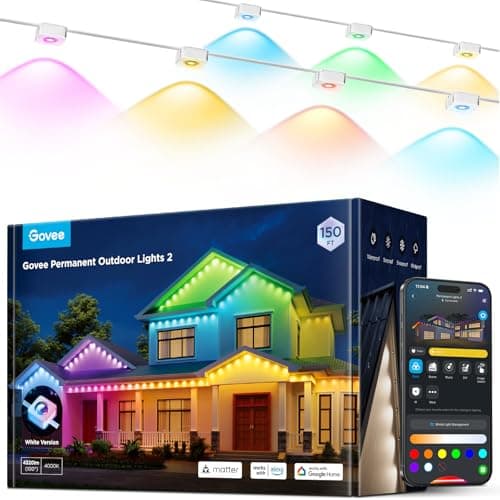 Top pickGovee Permanent Outdoor Lights 2, 150 ftRGBWIC, 40 lumens per light, not cuttable | A straight roofline you can light without cutting | 7.9 | $419.99 · View on Amazon |
| 2 | 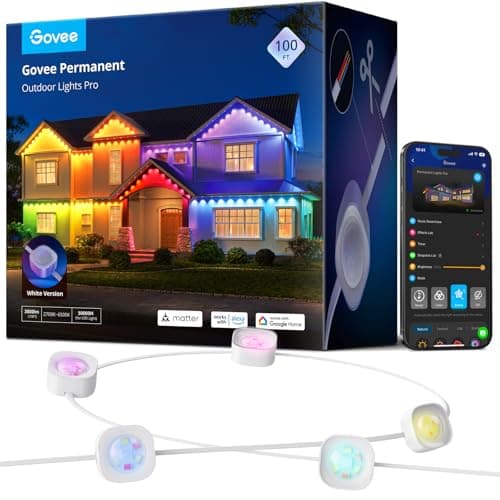 Govee Permanent Outdoor Lights ProRGBIC, app + voice control | DIY year-round eave lighting | 8.6 | $349.99 · View on Amazon |
| 3 | 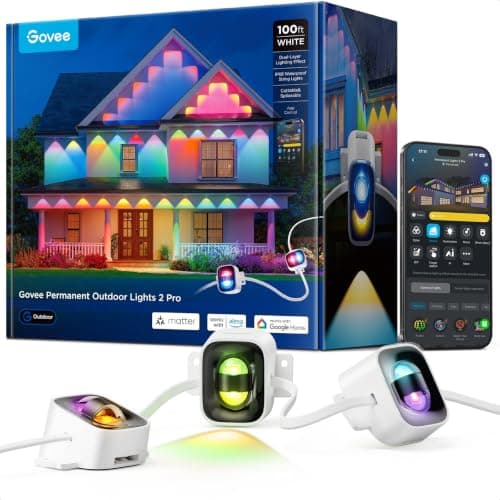 Govee Permanent Outdoor Lights 2 Pro, 100 ft100 ft / 60 lights, cuttable, IP68 | A permanent track trimmed to a complicated roofline | 8.8 | $499.99 · View on Amazon |
#ad We may earn a commission · Price as of October 23, 2026
Scores are our own editorial judgment from published specifications and buyer feedback, scored against the same criteria across this category. See how we pick.
Jump to a full review below: lights
Common questions
How much do permanent Christmas lights cost for a house?
Dealer-installed systems are published at roughly 18 to 35 dollars per linear foot, all in. Worked through real rooflines that comes to about 2,700 to 5,250 dollars for a 150 ft single-story ranch, about 3,240 to 6,300 dollars for a 180 ft two-story front, and about 4,500 to 8,750 dollars for a 250 ft full perimeter. Homeowner-installed kits cost a small fraction of that — in the region of 3 to 4.50 dollars per foot of hardware at current list prices — with your own labor on top.
Is the controller included in a permanent lighting quote?
It depends on the brand. Trimlight states its per-foot price is fully installed including the channel, bulbs, controller and labor. JellyFish prices the controller separately at 650 to 850 dollars, with one controller driving 263 feet of lights. On a long roofline, ask how many controllers the design needs before comparing two quotes.
Why are permanent Christmas lights so expensive?
Because almost none of the price is the LEDs. An installer who fits homeowner-supplied Govee hardware publishes the lights at roughly 3.80 dollars per foot against 18 to 21 dollars per foot for track and installation. The rest of a dealer quote is engineered channel, crew labor, insurance, programming and a long parts warranty.
Can you get permanent Christmas lights installed with your own kit?
Yes, with an independent installer. The published all-in figure for that hybrid is about 22 to 25 dollars per foot — lights at roughly 3.80 dollars per foot plus 18 to 21 dollars per foot for track and labor. The national dealer brands do not offer it because their pricing depends on bundling the hardware, so this is a question for a local installer rather than a franchise.
How long does it take permanent Christmas lights to pay for themselves?
Trimlight publishes a two-to-four-year break-even against paying for seasonal installation every year, and seasonal install services are cited at 1,000 dollars or more per season. If you hang your own lights, there is no break-even — a C9 run on reusable clips is cheaper up front and cheaper every year after. In that case the purchase is buying labor and safety, not savings.
What costs are left out of a permanent lighting estimate?
Most commonly: an exterior GFCI-protected outlet if you do not already have one in the right place, a second controller if the lit run exceeds one controller's capacity, the elevations the quote did not cover, and the labor warranty term, which is typically a minimum of one year from authorized dealers while parts coverage runs far longer. Ask for the service-call policy in year five in writing.
Sources
Every specification quoted on this page comes from the manufacturer’s own published information or a current retail listing, linked below. Where a figure is not published, we say so rather than estimating it.
- Trimlight — permanent Christmas lights 2026 pricing breakdown (18 to 35 dollars per linear foot installed; per-foot pricing reflects fully installed cost including channel, bulbs, controller and labor with no separate labor line; lifetime parts warranty while installed; authorized dealers back installation work for a minimum of one year; two-to-four-year break-even against repeated seasonal installation; 50,000-hour bulbs and channel)
- JellyFish Lighting — how much do permanent Christmas lights cost (25 to 35 dollars per linear foot installed; typical project 3,000 to 6,000 dollars for street-facing sides with an average around 4,600; controllers 650 to 850 dollars each; one controller powers 263 feet; system maximum 2,400 feet / 3,200 LEDs; seasonal installers cited at 1,000 dollars or more per year)
- 5280 Lights — Trimlight cost 2026 vs the open-hardware alternative (published 18 to 35 dollars per foot installed; worked project ranges of about 2,700-5,250 dollars for a 150 ft ranch, 3,240-6,300 for a 180 ft two-story and 4,500-8,750 for a 250 ft perimeter; homeowner-supplied Govee hardware at roughly 3.80 dollars per foot with track and installation at 18-21 dollars per foot for an all-in 22-25; note that quotes above the published range are frequently reported on complex two-story rooflines)
- Govee — Permanent Outdoor Lights Elite vs Pro (published list prices of 489.99 dollars for the 150 ft Elite kit and 599.99 dollars for the 150 ft Pro kit, read 2026-10-23)
- Philips Hue — Festavia Permanent outdoor lights (published list prices of 599.99 dollars for the 150 ft / 80-light kit and 399.99 dollars for the 90 ft kit, read 2026-10-23)
Read next
- Are permanent Christmas lights worth it?
- The best permanent outdoor Christmas lights
- Where to buy permanent Christmas lights
- Govee Permanent Outdoor Lights Elite: the review
- Philips Hue vs Govee outdoor lights
- DIY vs professional Christmas light installation
- How to measure your roofline for Christmas lights