Power, Cords & Timers
Can you leave Christmas lights on all night?
You can, and the safety guidance asks you not to. A timer settles the argument without you having to remember anything.
Mike M. — The hands-on owner behind Iron Mako Media.
Published
This page contains affiliate links. If you buy through them we may earn a commission at no cost to you, and it never decides what we recommend. How this site is funded.
The direct answer: nothing stops you, but the fire-safety guidance is consistent and specific: always turn decorative lights off before leaving the home or going to bed. The reason is not that LEDs get hot. It is that electrical failures and malfunctions are the leading cause of decorative-lighting fires, and an unattended fault burns for hours instead of minutes. The practical answer that satisfies everybody is a timer set to a six-hour evening window — it is safer, it costs a quarter as much to run, and you never have to remember anything.
What the guidance actually says
The recommendation to switch decorative lights off before bed or before leaving the house is standard across fire-safety sources, and it is worth understanding why it is phrased that way rather than as a prohibition. Nobody is claiming that a correctly installed LED string spontaneously ignites. The claim is about faults.
US fire departments respond to around 250 home structure fires caused by Christmas trees every year, and nearly half of those are caused by electrical problems. The same failure modes — a damaged conductor, a corroded connection, a cracked insulator, water in a plug — exist on an outdoor display, with weather added. A fault that occurs while you are awake and in the house is a smell and a tripped breaker. The same fault at three in the morning is unattended.
| Factor | Evening, awake | Overnight, asleep |
|---|---|---|
| A fault is noticed | Within minutes | Possibly not at all |
| GFCI trip is acted on | Immediately | In the morning |
| Hours of operation per night | About 6 | 12 or more |
| Running cost | 1x | 2x or more |
| Anybody actually looking at it | Yes | No |
The part about cost, which is smaller than you think
On an all-LED display the electricity is genuinely cheap, and anyone telling you overnight running will ruin you is overstating it. But the multiple is simple: doubling the hours doubles the cost, and the second half of those hours is spent lighting a street where everybody is asleep. What it costs to run Christmas lights has the arithmetic for your own display.
Where cost does bite is on anything with a motor. An inflatable's blower runs continuously the whole time the piece is up, and it draws far more than the LEDs inside it. If you leave one thing on a timer, leave the inflatables on one — see inflatable power draw.
The six-hour window, and why it is the right number
Dusk to bedtime is roughly six hours through December in most of the United States, and it covers every hour anybody actually looks at the display: the school run home, the evening, and the traffic going past until late. After that the audience is gone.
Six hours is also the number the industry has settled on. Battery decorations with built-in timers almost universally run a fixed 6-hours-on, 18-hours-off cycle — National Tree publishes exactly that on its pre-lit garland and wreaths. That figure exists because it is what a season of use looks like.
- A 7-day programmable outdoor timer is the most controllable version. A 15-amp, three-outlet weatherproof unit will run the facade and the yard on the same schedule, with a different schedule at weekends if you want one.
- A dusk-to-dawn photocell timer switches on by light level rather than by clock, which means it tracks the shortening days automatically. Pick a model with a run-time setting rather than true dusk-to-dawn, or you are back to all-night operation by design.
- A smart plug with sunset offsets is the version that needs no seasonal adjustment at all, because it computes sunset for your location and applies an offset. A dual-socket outdoor model lets the inflatables go off earlier than the lights.
- A mechanical dial timer works and never needs a manual, at the cost of 30-minute resolution and a dial that has to be reset after a power cut.
The comparison between those four is in photocell vs timer vs smart plug, and the products are in the best Christmas light timers. Setting one up takes about five minutes — how to set a Christmas light timer.
If you are going to leave them on anyway
Some people want the house lit all night and that is their call. If that is the decision, these four things reduce the risk it carries.
- Everything on a GFCI-protected circuit, tested before the season. This is the single most effective measure available and it costs nothing if the receptacle is already there.
- Every connection elevated and drip-looped. Water in a plug is the fault mode that overnight operation turns into a problem.
- All-LED, all outdoor-rated, no damaged strands. Retire anything with cracked insulation rather than running it unattended for a month.
- Nothing with a motor left running. Inflatable blowers are the one component on a display that is both mechanical and continuous. Put them on their own schedule even if the lights stay on.
And keep the whole thing inside the season. Holiday decorative lighting is permitted as a temporary installation — the National Electrical Code allows a period not exceeding 90 days for holiday decorative lighting, and UL 588 defines temporary use the same way. An all-night display in March is a different question from an all-night display in December, and the answer to it is in can you leave Christmas lights up all year.
What to buy
The products that fit the advice above, chosen by the process on our methodology page. Every specification quoted is the manufacturer’s own published figure, linked on the page.
Quick picks
| # | Product | Best for | Score | Price |
|---|---|---|---|---|
| 1 | 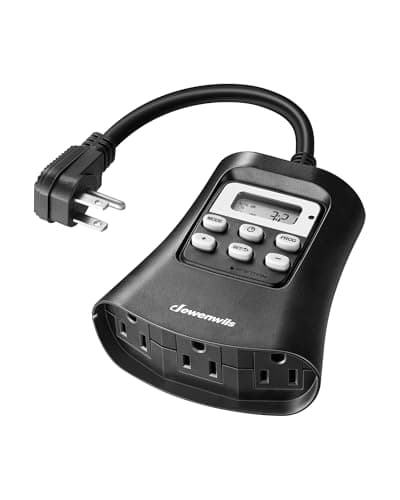 Top pickDEWENWILS Outdoor Digital Timer, 3 outlets, 15A15 A, 3 grounded outlets, 7-day | A whole display on one schedule | 9.1 | $18.99 · View on Amazon |
| 2 | 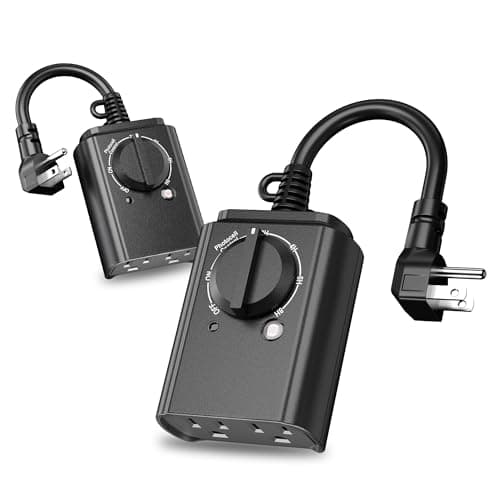 BN-LINK Outdoor Timer with Dusk-to-Dawn Sensor, 15APhotocell dusk-to-dawn, 15 A, 2 outlets | Set it once and never touch it | 8.9 | $22.79 · View on Amazon |
| 3 | 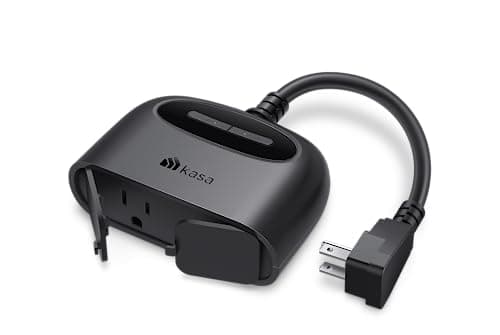 Kasa Outdoor Smart Plug (EP40)2 independent outlets, sunset offset | Sunrise/sunset scheduling and phone control | 8.8 | $22.99 · View on Amazon |
#ad We may earn a commission · Price as of October 17, 2026
Scores are our own editorial judgment from published specifications and buyer feedback, scored against the same criteria across this category. See how we pick.
Jump to a full review below: power-and-timers
Common questions
Can you leave Christmas lights on all night?
Nothing physically stops you, but fire-safety guidance consistently recommends turning decorative lights off before leaving the home or going to bed. The reason is faults rather than heat: electrical failure is the leading cause of decorative-lighting fires, and a fault that happens while you are awake is noticed in minutes while the same fault at three in the morning is not noticed at all.
Is it safe to leave outdoor Christmas lights on overnight?
Safer than indoor lights, and still not recommended. The specific conditions to avoid are a display that has already tripped a GFCI, a connection sitting in standing water, or a strand with visible insulation damage. If the display is all-LED, outdoor-rated, GFCI-protected and undamaged, overnight operation is a cost and convenience question more than a safety one.
How many hours a day should Christmas lights be on?
About six, covering dusk to bedtime. That window includes every hour anybody actually looks at the display, and it is the figure the industry has settled on — battery decorations with built-in timers almost universally run a fixed 6-hours-on, 18-hours-off cycle.
Do Christmas lights use a lot of electricity overnight?
On an all-LED display, no — the electricity is genuinely cheap, and doubling the hours simply doubles a small number. Where overnight running does cost real money is anything with a motor: an inflatable's blower runs continuously and draws far more than the LEDs inside it. If you put one thing on a timer, put the inflatables on it.
What is the best way to stop leaving the lights on?
A timer, so the decision is made once. A 7-day programmable outdoor timer is the most controllable, a dusk-to-dawn photocell with a run-time setting tracks the shortening days automatically, and a smart plug with sunset offsets needs no seasonal adjustment at all because it computes sunset for your location.
Sources
Every specification quoted on this page comes from the manufacturer’s own published information or a current retail listing, linked below. Where a figure is not published, we say so rather than estimating it.
- Fire Engineering, reporting NFPA — fire risk around the winter holidays (approximately 250 home structure fires a year caused by Christmas trees, nearly half from electrical problems; always turn Christmas tree lights off before leaving the home or going to bed)
- ESFI — outdoor decoration safety tips (GFCI protection, outdoor-marked cords, keep connections out of standing water)
- IAEI Magazine — holiday lighting requirements and the NEC (UL 588 defines temporary use as a period not exceeding 90 days; NEC 590.3(B) permits holiday decorative lighting for a period not to exceed 90 days; NEC 410.160 requires decorative holiday lighting to be listed)
- Electrical Safety Authority — holiday safety tips (decorative lighting, cords and unattended displays)
- National Tree Company — 9 ft pre-lit Carolina Pine garland, published 6 hours on / 18 hours off timer cycle
- Amazon — DEWENWILS outdoor digital timer, 15 A, 3 grounded outlets, 7-day programmable, UL listed
- Amazon — BN-LINK dusk-to-dawn outdoor timer, 15 A, ETL listed