Outdoor Christmas Lights
How to wrap a tree trunk with Christmas lights
Wrapping is the one outdoor job where running short is unfixable. Do the arithmetic first, then wind the string into a ball before you touch the tree.
Mike M. — The hands-on owner behind Iron Mako Media.
Published
This page contains affiliate links. If you buy through them we may earn a commission at no cost to you, and it never decides what we recommend. How this site is funded.
The direct answer: measure the trunk's circumference and the height you intend to wrap, then calculate height in inches divided by your wrap spacing, multiplied by the circumference — that is the length of light you need in inches. Use 5 mm wide-angle mini lights at 6 to 8 inch bulb spacing for a natural look, or closer for full coverage. Wind each string into a ball before you start, wrap upward from the base with the string pulled tight, and on branches wrap out to the tip and then back down to fill the gaps.
Do the arithmetic before you buy
A trunk eats light at a rate nobody estimates correctly by eye, because each wrap travels a whole circumference rather than an inch of height. Decorators Warehouse publishes the formula for exactly this calculation on columns, and a trunk is a column with bark: take the height in inches, divide by the spacing you want between wraps, and multiply the resulting number of wraps by the circumference.
| Trunk circumference | 4 in wrap spacing | 6 in wrap spacing | 8 in wrap spacing |
|---|---|---|---|
| 12 in (about 4 in thick) | 18 ft | 12 ft | 9 ft |
| 24 in (about 8 in thick) | 36 ft | 24 ft | 18 ft |
| 36 in (about 11 in thick) | 54 ft | 36 ft | 27 ft |
| 48 in (about 15 in thick) | 72 ft | 48 ft | 36 ft |
Measure circumference with a tape right around the trunk at chest height, not the width. Then add the branches: Christmas Lights Etc notes that most outdoor trees are wrapped the length of the trunk plus roughly 3 to 4 feet into the extending branches, and a branch wrapped out and back uses double its own length. Add a strand on top of whatever you calculate, because running out three feet from the top cannot be fixed without unwrapping everything.
What to wrap with
- 5 mm wide-angle LED mini on green or brown wire. The default and the right answer for almost every trunk. Wide-angle optics throw light sideways, which is what a wrapped surface needs, and brown wire disappears against bark in daylight.
- Stretch net tree wrap. A pre-spaced expandable net that goes around a trunk in one pass instead of thirty. Transforms a twenty-minute job into a two-minute one and is the sensible choice if you have several trunks to do. Less good on a trunk that tapers sharply or has heavy bark texture.
- Not C9 or C7. A large faceted bulb on a trunk sits proud of the bark, snags, and reads as a handful of lamps rather than a spiral of light. Save those for the roofline.
- Not incandescent minis on a long chain. The end-to-end connection limit is far lower, which matters when a single tree can want five or six strings.
The method, in order
- 1
Ball the string first
Wind each string into a loose ball — or buy pre-balled sets — before you go near the tree. A ball feeds through branches with one hand; a loose 24-foot string catches on every twig and will tangle around the trunk you are trying to wrap.
- 2
Start at the base, plug end down
Begin at the bottom with the male plug at ground level so your only cord at ground level is the feed to the outlet. Wrap upward. Starting at the top leaves the plug stranded eight feet up a tree.
- 3
Pull tight at every pass
The string should be snug against the bark. A loose wrap sags into the one below it within a week of wind and the spacing you carefully set is gone. Tight also keeps the wire out of the way of bark growth.
- 4
Chain string to string as you go
When you reach the end of one string, plug the next into it and keep wrapping. Check the end-to-end connection limit printed on the tag first — 5 mm LED sets allow a generous number, with some suppliers stating up to 80 strands end to end, but the tag on your own set is the authoritative figure.
- 5
Branches: out, then back
Wrap up the length of the branch, then wrap back down it filling in the gaps. One pass out leaves a striped branch; out-and-back is what makes a branch read as lit. This is also why a branch consumes double its own length in light.
- 6
Secure the final end
Tuck the end under a nearby wrap, or use a zip tie. Black or clear, and cut it off at takedown rather than leaving it to bite into the bark.
Power and the run across the lawn
A wrapped tree is almost always away from the house, which makes the cord the second half of the job. Use an outdoor-rated SJTW cord sized for the run, keep the connection between cord and lights elevated off the ground and pointing downward so water drains away from it, and never run a cord across a walkway or driveway where it can be driven or tripped over.
On a lawn, light stakes keep the feed cord off the wet ground and out of the mower line in spring, and they are cheap. Cord sizing is in best outdoor extension cords; the total load check is in christmas light amps and watts.
Three things that go wrong
- Running short. The commonest failure and the only unfixable one. Buy a strand more than the formula says.
- Spacing that drifts. Tight and careful at the bottom, stretched and sparse at the top because you could see you were running out. The fix is buying enough, not wrapping faster.
- Leaving the wrap on all year. A string pulled tight around a growing trunk will girdle it over several seasons. If you want year-round lighting on a tree, take it off each spring and re-wrap, or use stakes and uplighting instead. Takedown timing is in when to take down Christmas lights.
For the quantity question across a whole display rather than one tree, how many Christmas lights do I need does the house-wide version of this arithmetic, and best outdoor Christmas lights for trees covers which sets hold up on a trunk over several winters.
What to buy
The products that fit the advice above, chosen by the process on our methodology page. Every specification quoted is the manufacturer’s own published figure, linked on the page.
Quick picks
| # | Product | Best for | Score | Price |
|---|---|---|---|---|
| 1 | 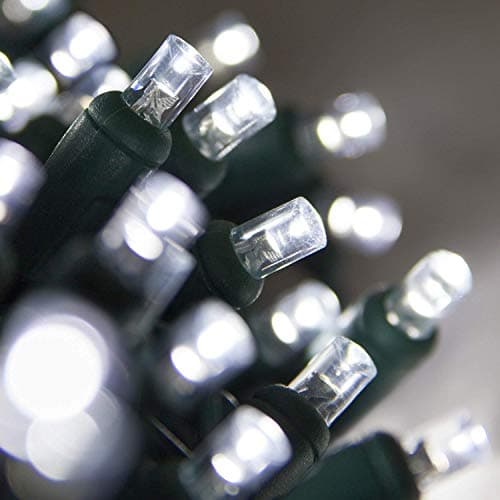 Top pick5 mm Wide Angle LED Mini Lights, 70 ct, green wire70 bulbs / 24 ft, 5 mm wide angle | Wrapping trunks and branches | 9.0 | $24.99 · View on Amazon |
| 2 | 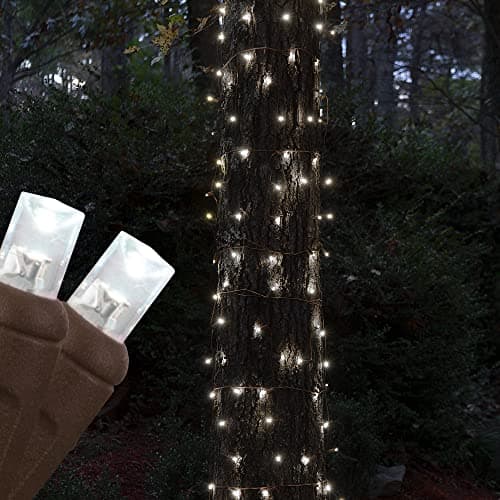 Wintergreen Lighting 70 Cool White StretchNet Pro Tree Wrap Lights70 cool white 5 mm, expandable net | Wrapping a trunk in minutes | 8.7 | $23.99 · View on Amazon |
| 3 | 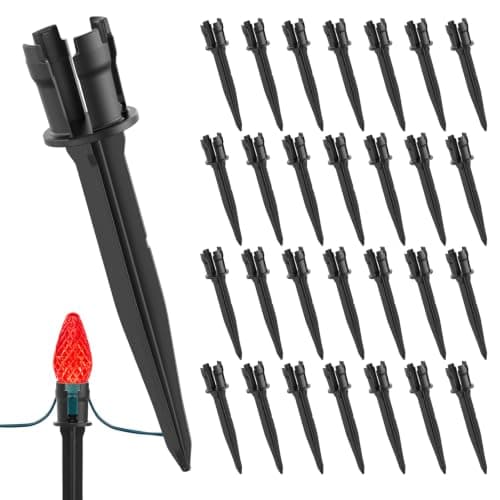 Christmas Light Stakes for C7/C9 string lightsFor C7/C9 string, multi-pack | Pathways, walkways and bed edges | 8.2 | $27.99 · View on Amazon |
| 4 | 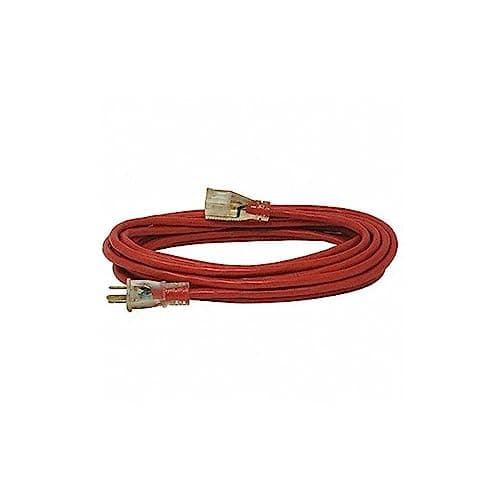 Southwire 14/3 SJTW Outdoor Extension Cord, lighted end14/3 SJTW, 13 A rated | The standard run from house to display | 9.0 | $19.30 · View on Amazon |
#ad We may earn a commission · Price as of October 10, 2026
Scores are our own editorial judgment from published specifications and buyer feedback, scored against the same criteria across this category. See how we pick.
Jump to a full review below: lights
Common questions
How many lights do I need to wrap a tree trunk?
Divide the height you are wrapping, in inches, by your wrap spacing to get the number of wraps, then multiply by the trunk circumference. A 6-foot section of trunk with a 24-inch circumference at 6-inch spacing needs 12 wraps of 24 inches, which is 288 inches or 24 feet. Add a strand, and add double the length of any branch you wrap out and back.
What spacing should I use when wrapping a trunk?
Six inches between bulbs is the standard recommendation for the best look, and 6 to 8 inches lets the wires sit snugly in the branches. Closer wraps give the intense full-coverage look at roughly double the footage. Pick the look before you buy, because the two need very different quantities.
Do you wrap tree lights from the top or the bottom?
From the bottom, with the plug end at ground level, so the only cord at ground level is the feed to your outlet. Wrap upward with the string pulled tight, then extend into the main branches. Starting at the top leaves the plug stranded high in the tree.
How do you wrap the branches, not just the trunk?
Wrap up the length of the branch, then wrap back down it filling in the gaps. One pass out leaves a branch that reads as stripes; out-and-back is what makes it read as lit. Most outdoor trees are wrapped up the trunk plus about 3 to 4 feet into the extending branches.
Can I leave the lights wrapped around the tree all year?
Not safely for the tree. A string pulled tight around a trunk that is still growing will girdle it over several seasons. If you want the tree lit year-round, unwrap and re-wrap each spring, or switch to ground stakes and uplighting instead.
Sources
Every specification quoted on this page comes from the manufacturer’s own published information or a current retail listing, linked below. Where a figure is not published, we say so rather than estimating it.
- Christmas Lights Etc — wrapping trees with lights (6 in bulb spacing for the best look, 6-8 in so wires wrap snugly, trunk plus 3-4 ft into extending branches, ball the string first, start at the base and wrap upward, wrap out the branch and back down to fill gaps, secure the end with a zip tie)
- Decorators Warehouse — tree and column lighting with 5 mm mini lights (height divided by spacing equals wraps; wraps times circumference equals total length; up to 80 strands end to end; zip-tie to shorten a strand)
- Christmas Lights Etc — 5 mm StretchNet Pro tree wrap lights, brown wire
- ESFI — outdoor decoration safety tips (outdoor-marked cords, GFCI protection, keep connections clear of snow and standing water)
- Wintergreen Lighting — 5 mm wide angle LED mini light specifications
Read next
- The best outdoor Christmas lights for trees
- The best Christmas lights for porch columns
- C9 bulb spacing: how far apart should they be?
- How many Christmas lights do I need for my house?
- How to measure your roofline for Christmas lights
- The best outdoor extension cords for Christmas lights
- The best outdoor Christmas lights for cold weather