Outdoor Christmas Lights
The best multicolor outdoor Christmas lights
Multicolor splits into two completely different products. One is a bulb that is permanently red; the other is a bulb that can be any color. Pick the category first.
Mike M. — The hands-on owner behind Iron Mako Media.
Published
This page contains affiliate links. If you buy through them we may earn a commission at no cost to you, and it never decides what we recommend. How this site is funded.
Quick picks
| # | Product | Best for | Score | Price |
|---|---|---|---|---|
| 1 | 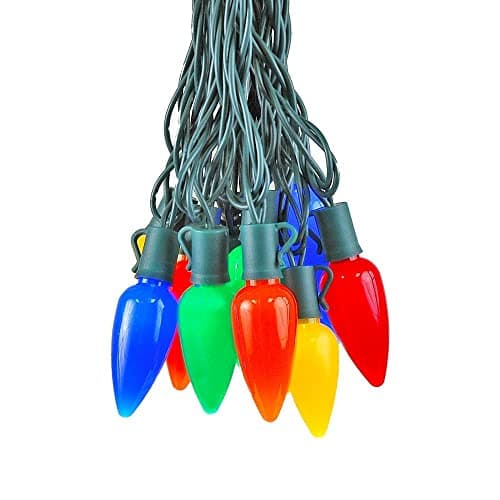 Top pickNovelty Lights 25 ft C9 Ceramic Style LED String Lights, multicolor25 ft, ceramic-style LED, multicolor | Opaque, saturated color instead of clear glass | 8.5 | $22.98 · View on Amazon |
| 2 | 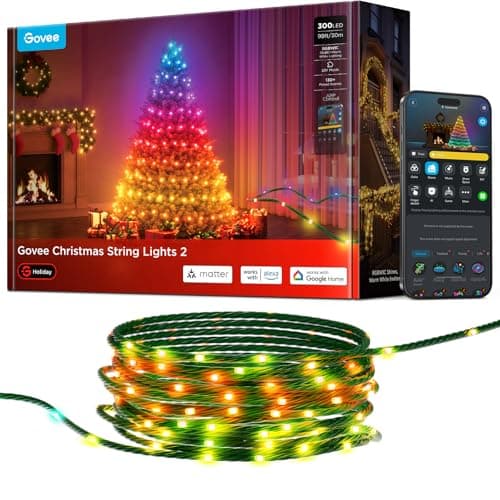 Govee Christmas Lights 2, 99 ft / 300 LED RGBIC99 ft, 300 LED RGBIC, IP65 | Music-reactive lights that can live outside all season | 8.9 | $103.99 · View on Amazon |
| 3 | 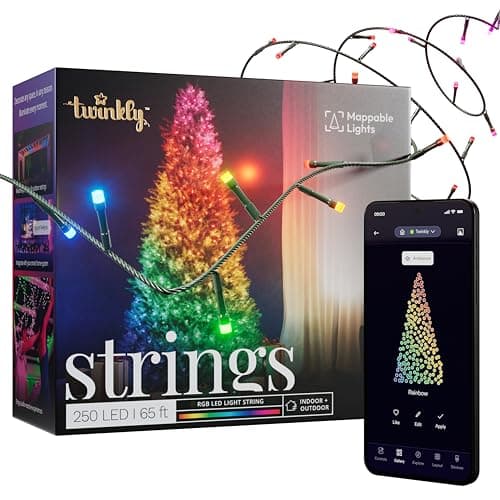 Twinkly Strings 250 RGB, 66.5 ft250 RGB LEDs, 66.5 ft, app mapped | Music-reactive lights with no sequencing at all | 8.8 | $124.99 · View on Amazon |
| 4 | 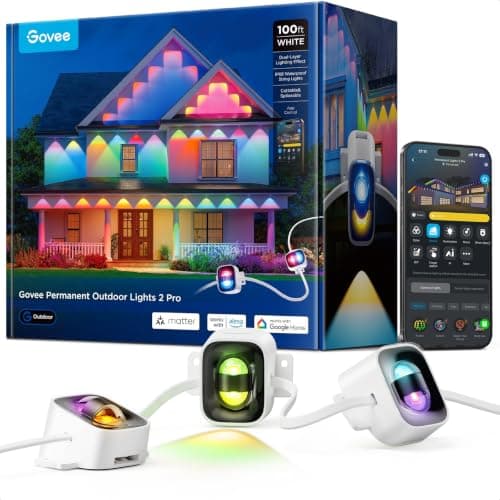 Govee Permanent Outdoor Lights 2 Pro, 100 ft100 ft / 60 lights, cuttable, IP68 | A permanent track trimmed to a complicated roofline | 8.8 | $399.99 · View on Amazon |
| 5 | 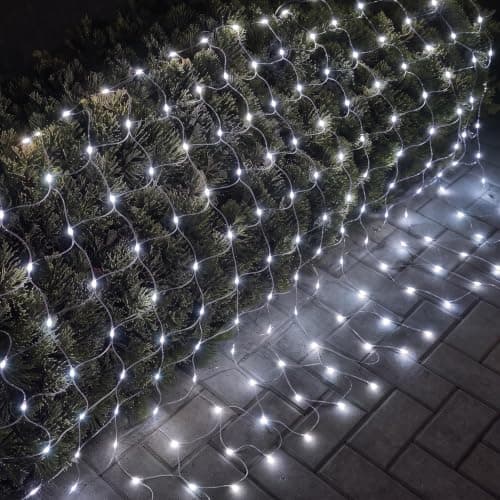 Dazzle Bright Christmas Net Lights360 LEDs, 8 modes | Bushes and hedges, done in ten minutes | 8.7 | $24.99 · View on Amazon |
#ad We may earn a commission · Price as of October 10, 2026
Scores are our own editorial judgment from published specifications and buyer feedback, scored against the same criteria across this category. See how we pick.
Jump to a full review below: lights
The short version: if you want the traditional multicolor roofline, buy opaque ceramic-style C9 LEDs — our top pick is a 25-foot ceramic C9 set, because opaque bulbs hold saturated color at distance where a clear faceted bulb washes out to pale pastel. If you want a display that is red and green in December and orange in October, you are not buying multicolor bulbs at all; you are buying an addressable RGBIC strand, and Govee's 99-foot IP65 set is the one with the outdoor rating to match the ambition.
The two halves of the multicolor market
Searching for multicolor Christmas lights returns two products that have almost nothing in common beyond the word. Choosing between the categories is the whole decision; choosing within a category is comparatively easy.
| Fixed-color bulbs | Addressable RGB / RGBIC | |
|---|---|---|
| What a bulb is | A permanently red, green, blue, orange or white lamp | One LED that can be any color on command |
| How you change it | You swap bulbs | App, remote or voice |
| Pattern control | The repeat you buy is the repeat you get | Per-bulb patterns, chases, music sync |
| Replaceable bulbs | Usually yes on C7 / C9 | No — a failed section is a section |
| Needs Wi-Fi | No | For scheduling and scenes, yes |
| Right for | A classic roofline you leave alone all season | A display you want to change through the year |
Opaque or faceted: the difference nobody explains in the listing
Within fixed-color bulbs there is a second fork that matters more than brand. A clear faceted C9 lens throws light outward through cut facets and sparkles close up, but at street distance the color reads thin — a faceted red reads pink, a faceted green reads lime. A ceramic-style opaque lens is pigmented plastic: it does not sparkle, but the color stays saturated at forty feet because you are looking at the lens, not through it.
- Opaque / ceramic style — saturated, flat, traditional. This is the look most people picture when they say multicolor Christmas lights, and it is why vintage displays read so strongly in photos.
- Clear faceted — sparkly and brighter per bulb, pastel at distance. Better on a close surface like a porch rail or a wreath than on a two-story roofline.
- Smooth clear — the compromise. Less sparkle than faceted, more saturation. Common in LED retrofit bulbs.
The color repeat, and why five-color sets look busy
A fixed-color set has a repeat pattern printed into it — commonly red / green / blue / orange / white on a five-color set, or red / green on a two-color set. The more colors in the repeat, the more a long run reads as visual noise rather than a pattern, because at forty feet you cannot resolve the sequence. Professional installers overwhelmingly run two- or three-color repeats on a roofline for this reason, and save five-color for short accent runs.
- Two-color (red / green) — unmistakably Christmas, reads cleanly at any distance, and the easiest to make look deliberate.
- Three-color (red / green / white) — the warm-white break stops the run reading as a solid block of color. The best default for a whole house.
- Five-color — the childhood look, at its best in a short run: a porch, a path, a single tree. On 120 feet of eave it turns to static.
- Single color plus warm white — the most modern-looking option and almost nobody buys it. Worth considering.
If you choose addressable RGB, check these three things
Addressable sets all advertise sixteen million colors, music sync and app control. Those are table stakes. Three specifications actually separate them, and only one is about color.
- Ingress rating. Govee publishes IP65 on its 99-foot Christmas string set, which is protection against water jets from any direction and the sensible floor for an outdoor seasonal run. A set with no published rating is an indoor set with an outdoor photograph.
- RGBIC vs plain RGB. Plain RGB means the whole strand is one color at a time. RGBIC means segments are independently addressable, which is what makes a chase or a multi-color pattern possible at all. If you want a multicolor look from an addressable set, RGBIC is not optional.
- Whether it has real white. An RGB bulb mixing red, green and blue to make white produces a white with a visible tint. Sets that add a dedicated white diode — the extra letters in RGBW, RGBAICW — are the ones whose warm white actually looks like warm white. See warm white vs cool white.
Mixing multicolor and white on one house
The most common planning mistake is treating this as one choice for the whole property. It is not. A display reads best when the colors are assigned by surface: a multicolor roofline with warm-white trees, or warm-white eaves with multicolor bushes and path. What fails is multicolor everywhere at the same density, because nothing in the composition is resting.
If you are starting from scratch, the first-time display plan sets out a running order, and how many Christmas lights do I need gives you the footage per surface before you decide which surface gets color.
Power, briefly
Color does not change the draw of an LED set in any way you need to plan around; length and bulb count do. A multicolor C9 LED run and a warm-white C9 LED run of the same length draw within a few watts of each other. The constraint, as always, is the end-to-end connection limit on the tag and the 1,440-watt working budget on a 15-amp circuit. Christmas light amps and watts has the arithmetic.
How we picked
Published manufacturer specifications, retailer listings read in full, and the lens-construction differences visible in the product photography. Every figure is linked below. See methodology.
The picks in full
Top pick
Novelty Lights 25 ft C9 Ceramic Style LED String Lights, multicolor
Novelty Lights
Ceramic-style opaque C9 bulbs in a commercial string. The color reads solid at distance rather than as a bright point, which is what most people picture when they picture C9 multicolor.
There are two kinds of C9 bulb and the listings rarely make the difference clear. Transparent faceted bulbs sparkle and throw light; opaque ceramic bulbs glow as a solid block of color. From fifty feet away on a roofline, the opaque version is what most people have in their head when they say they want old-fashioned Christmas lights.
Novelty Lights sells the opaque version in a standard 25-bulb commercial string on green wire, at a price below the top-tier commercial lines. The bulbs use the same E17 base as every other C9 on this page, so spares are interchangeable across brands — a genuinely useful property that nobody advertises.
The trade-off is light output onto the house. If you want the facade lit, faceted or smooth transparent bulbs do that and these do not. If you want the roofline outlined in color against a dark house, these do it better. It is an aesthetic decision, not a quality one.
We could not find a published rated-hours figure for this line, so we are not quoting one. That is a gap in the manufacturer's own documentation rather than a mark against the product.
What works
- Opaque finish reads as solid color from the curb, not as a glare point
- Replaceable bulbs, same E17 base as other commercial C9
- Cheaper than the premium commercial lines
What does not
- Opaque bulbs throw less light onto the house itself
- Manufacturer does not publish a rated-hours figure for this line
- Green wire is the only common option
| Bulb | C9, E17 base, LED, opaque ceramic finish |
|---|---|
| Set | 25 bulbs, green wire |
| Voltage | 120 V |
| Colors | Multicolor and single-color options |
| Connectable | Yes, end to end |
Music-reactive lights that can live outside all season
Govee Christmas Lights 2, 99 ft / 300 LED RGBIC
Govee
IP65 and cold-rated to -20 C, with built-in music modes and app scheduling. The reactive option that is genuinely specified for the weather it will sit in.
The specification that separates outdoor smart string lights from indoor ones sold with an outdoor photo is the pair of numbers on the box: ingress rating and cold rating. Govee states IP65 and cold resistance to -20 C for this line. Sixty-five is protection against water jets from any direction, which is what a string on a fascia in a December storm experiences, and a stated low-temperature figure tells you the manufacturer expects the insulation to stay flexible rather than going brittle and cracking on the first hard night.
RGBIC is the other term worth decoding. A plain RGB string is one color at a time across the whole run. RGBIC segments are independently addressable, so a color can travel along the string — which is what makes a music mode look like motion rather than like the whole house flashing in unison.
Govee builds the music modes into the product, with 10-plus reactive modes and a large library of preset scenes, controlled from the app and addressable by voice. Practically, that means there is no separate sensor to buy and no indoor-only dongle to site, which is the constraint that trips people up on the competing system.
Two things to be realistic about. The lights react to sound picked up near the control box, so if the box is behind the shrubs on a quiet street the reaction will be weak — site it where the music actually is. And a color-changing string is a distinct aesthetic; on a house whose roofline is matched warm-white C9, a saturated RGB run alongside it will fight rather than complement. Pick one language for the front of the house.
What works
- IP65 and a stated -20 C cold rating — specified for real winter
- RGBIC means color moves along the string instead of the whole run changing at once
- Music modes are built in; no dongle to buy or site indoors
- App scheduling replaces a separate outdoor timer
What does not
- Reacts to sound near the controller, so placement decides how well it tracks
- Needs Wi-Fi coverage at the front of the house
- Color-changing string is a different look from a matched warm-white roofline
| Length | 99 ft, green wire |
|---|---|
| LEDs | 300, RGBIC (independently addressable segments) |
| Ingress rating | IP65 (Govee published figure for this line) |
| Cold rating | -20 C (Govee published figure for this line) |
| Music modes | 10+ music-reactive modes |
| Scenes | 130+ preset animated scenes |
| Control | Govee Home app, Alexa, Google Assistant |
Music-reactive lights with no sequencing at all
Twinkly Strings 250 RGB, 66.5 ft
Twinkly
The shortest path from nothing to app-mapped lights. The app learns the real shape of the string with your phone camera, so effects follow the house rather than running blindly down the wire.
There are two completely different things people mean by lights that dance to music. One is a designed show, where every bulb is sequenced against a track. The other is reactive lighting, where the lights respond to whatever is playing. They need different hardware, and buying the wrong one is the most common mistake in this category.
Twinkly is the reactive answer, and it is the easiest of the two by a wide margin. The app maps the physical positions of the LEDs on your house using your phone's camera, which is what lets effects move across the string in space rather than just chasing along the wire in order. Add the Music dongle — a USB sound sensor with BPM detection — and the lights respond to music in the room without a sequence, a computer or a single wiring decision. Twinkly notes the dongle runs independently once set up, so you do not have to leave the app open.
RGB+W is worth understanding as a spec. A plain RGB string makes white by mixing red, green and blue, and outdoors it reads slightly off. The dedicated white channel on the +W version produces an actual warm white, which matters enormously if the rest of your house is warm-white C9.
The limitation you must plan around is placement. The string is rated IP44, which is weather resistant — fine on a facade, not something to leave in a puddle. And Twinkly specifies the Music dongle itself for indoor use only, so the sensor lives inside on a windowsill while the lights are outside. That works, but it means the dongle hears what is playing indoors, not what is playing in the yard.
What works
- No sequencing software, no computer, no wiring — the app maps the string
- Dongle runs independently once set up, so the app does not have to stay open
- Sixty-six feet is enough for a real roofline run rather than a single tree
- Wi-Fi plus Bluetooth makes setup and later control both straightforward
What does not
- Music reaction needs the separate sound sensor — it is not in this box
- RGB only, so white is mixed from the colored diodes rather than its own channel
- Reacts to ambient sound rather than playing a designed show
- Locked to Twinkly's own product line
| LEDs | 250 RGB |
|---|---|
| Length | 66.5 ft, black wire |
| Use | Indoor / outdoor |
| Connectivity | Wi-Fi and Bluetooth |
| Mapping | The app maps the string so effects follow its real shape |
| Music | Needs the separate Twinkly Music sound sensor |
A permanent track trimmed to a complicated roofline
Govee Permanent Outdoor Lights 2 Pro, 100 ft
Govee
The permanent-lighting model explicitly designed to be cut and reconnected, which is what lets it fit a roof with gables and returns instead of forcing the roof to fit the kit.
Permanent lighting and trimmable lighting overlap at exactly one point: a track you mount once has to match the roofline exactly, because you will be looking at it in July. Govee's Pro models are the ones specified for that. Govee describes the 2 Pro as designed to be cut, extended or reconnected to fit different eave lengths and complex rooflines, and sells it as 100 ft and 200 ft kits with a 200 ft total cap once extensions are added.
The model naming is the trap here and it is worth spelling out. Govee's permanent range contains models that are cuttable and models that are not — the Permanent Outdoor Lights 2 is listed as not supporting cutting, while the Pro models are. If trimming to length is the reason you are buying, the word Pro in the product name is doing load-bearing work.
The specification that separates this from an ordinary string is IP68 on the strand, with the Y connector also IP68 and the control box and power adapter at IP67. That is a fully sealed run with a slightly less sealed brain, which is the right way round: the strand sits on the fascia in the weather for years, and the control box can be sited somewhere sheltered.
What you should not expect is invisibility. A permanent track is a visible line under the eave in daylight on every system sold, and any listing photo implying otherwise was taken at night. Color-matched to the fascia it reads as trim, which is the honest best case.
The lengths, LED count, spacing, ingress ratings and the cut-and-reconnect capability above are Govee's published figures, linked in the sources below.
What works
- Cut-and-reconnect is a published capability, not a modification you improvise
- IP68 on the strand is the highest ingress rating in DIY permanent lighting
- One install covers Christmas, Halloween and year-round accent light
- Matter support means it is not locked to a single app forever
What does not
- Costs several seasons' worth of retail C9, and the warranty is short by permanent-lighting standards
- The 200 ft total cap is a real constraint on a large or multi-elevation house
- Non-Pro Govee permanent models do not support cutting — the model name matters
- It is a visible track under the eave in daylight, like every system of this type
| Lengths | 100 ft (H3A51) and 200 ft (H3A53) |
|---|---|
| LEDs | 60 lights on the 100 ft model, roughly 40 cm spacing |
| Ingress rating | IP68 strand and Y connector; IP67 control box and adapter |
| Cuttable | Yes — Govee states the run can be cut, extended and reconnected |
| Max total length | 200 ft (60 m) including extensions, per Govee |
| White range | 1000K-10000K, dual-layer color effect |
| Control | App, 100 preset scenes, Music Sync, Matter, Alexa, Google Assistant |
Bushes and hedges, done in ten minutes
Dazzle Bright Christmas Net Lights
Dazzle Bright
A mesh of LEDs you throw over a shrub. It is the highest ratio of visible result to time spent of anything on this site, and it is why net lights belong in most first displays.
Net lights solve one problem completely: covering a bush. Wrapping a shrub by hand takes twenty minutes and looks hand-wrapped. A net takes about ninety seconds and looks even, because it is a grid.
Dazzle Bright's sets run 360 LEDs in a mesh with eight modes. The mode controller is more useful than it sounds — on a bush the steady setting is almost always right, but the slow-fade setting reads well on a hedge line where a steady wall of light looks flat.
Where nets fail is geometry. They want a roughly rectangular volume. A tall juniper, an irregular ornamental grass, or a sparse young shrub will let the net sag into it and you get a lumpy result that reads as cheap. Measure the bush: if it is meaningfully taller than the net is wide, buy string and wrap it.
Takedown is the quiet advantage. A net comes off in one motion and folds. A wrapped shrub has to be unwrapped, in the cold, in January, and that is the job everyone underestimates.
What works
- Covers a shrub in one throw — no wrapping, no ladder
- Even spacing looks deliberate in a way hand-wrapped string never does
- Packs down flat, unlike a wrapped bush that has to be unwrapped
What does not
- Only works on roughly cube-shaped shrubs; it sags off tall or sparse ones
- A snagged mesh is harder to untangle than a string
- Fixed LEDs — no bulb replacement
| Type | Net / mesh |
|---|---|
| LED count | 360 (per the manufacturer listing) |
| Modes | 8 |
| Colors | Multicolor and warm white options |
| Use | Outdoor rated |
| Connectable | Yes on most sets |
Common questions
What are the best multicolor outdoor Christmas lights?
For a traditional roofline, opaque ceramic-style C9 LED bulbs — the opaque lens keeps red and green saturated at street distance where a clear faceted bulb reads pink and lime. For a display you want to recolor through the year, an addressable RGBIC strand with a published outdoor ingress rating is the right product instead.
Why do my multicolor lights look washed out from the street?
Almost always because the bulbs are clear and faceted. A faceted lens throws light out through cut facets, which sparkles close up but dilutes the color at distance. Opaque, ceramic-style pigmented lenses hold saturation because you are looking at the lens rather than through it.
How many colors should a multicolor set have?
Two or three for a whole roofline — red and green, or red, green and white. At forty feet you cannot resolve a five-color repeat, so it reads as noise rather than a pattern. Save five-color sets for short accent runs like a porch, a path or a single tree.
Is RGB the same as multicolor?
No. A multicolor set has bulbs that are permanently one color each. An RGB set has bulbs that can be any color, but plain RGB sets light the whole strand one color at a time. To get a multicolor look from an addressable set you need RGBIC, where segments are independently addressable.
Do multicolor LED lights use more electricity than white ones?
No, not in any amount worth planning around. Draw is set by bulb count and length, not by color, so a multicolor C9 LED run and a warm-white one of the same length are within a few watts of each other. The real limits are the end-to-end connection count on the tag and the circuit budget.
Sources
Every specification quoted on this page comes from the manufacturer’s own published information or a current retail listing, linked below. Where a figure is not published, we say so rather than estimating it.
- Walmart — Novelty Lights LED Multi C9 Ceramic outdoor set, green wire, 25 bulbs, 120 V (ceramic-style opaque lens)
- Govee — Christmas String Lights 2, 99 ft / 300 LED RGBIC, IP65 (published ingress rating and per-segment addressing)
- Wintergreen Lighting — C9 LED Christmas light specifications (lens types and bulb construction)
- Twinkly — Music dongle and app-mapped RGB strings
- 1000Bulbs — Christmas mini lights buying guide (bulb spacing by application)