Outdoor Christmas Lights
The best Christmas lights for a front door frame
A doorway is read from six feet away, not from the street. That single difference changes the bulb, the spacing and how the whole thing is powered.
Mike M. — The hands-on owner behind Iron Mako Media.
Published
This page contains affiliate links. If you buy through them we may earn a commission at no cost to you, and it never decides what we recommend. How this site is funded.
Quick picks
| # | Product | Best for | Score | Price |
|---|---|---|---|---|
| 1 | 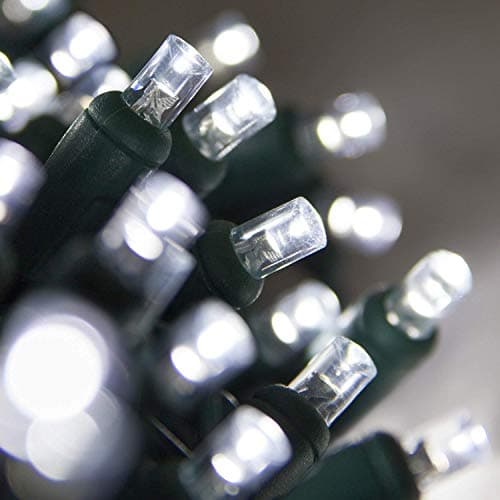 Top pick5 mm Wide Angle LED Mini Lights, 70 ct, green wire70 bulbs / 24 ft, 5 mm wide angle | Wrapping trunks and branches | 9.0 | $24.99 · View on Amazon |
| 2 |  National Tree Company 9 ft Pre-Lit Carolina Pine Garland, warm white LED9 ft, 240 tips, 100 warm white LED, 6/18 timer | A door surround with no outlet near it | 9.0 | $49.49 · View on Amazon |
| 3 | 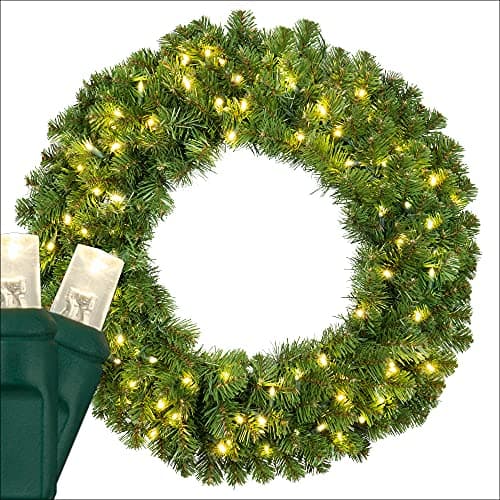 Red Sleigh 30 in Sequoia Fir Commercial-Grade Pre-Lit Wreath, 100 warm white LED30 in, 100 LED, 240 tips, 7 W | A wreath that sits in open weather | 9.1 | $158.99 · View on Amazon |
| 4 | 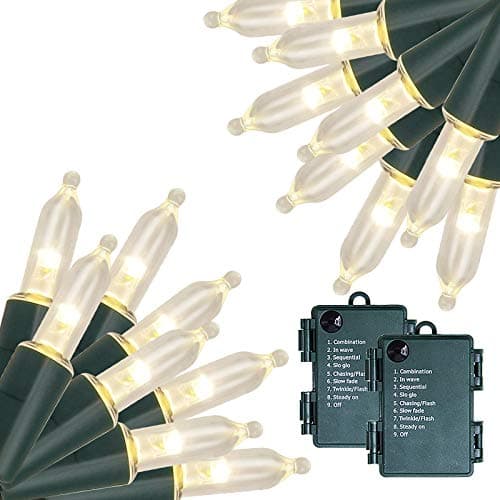 Twinkle Star Battery Operated String Lights, 16 ft / 50 LED, 2-pack16 ft, 50 LED warm white, 2-pack | Wreaths, garland and anything on a door | 7.8 | $14.99 · View on Amazon |
| 5 | 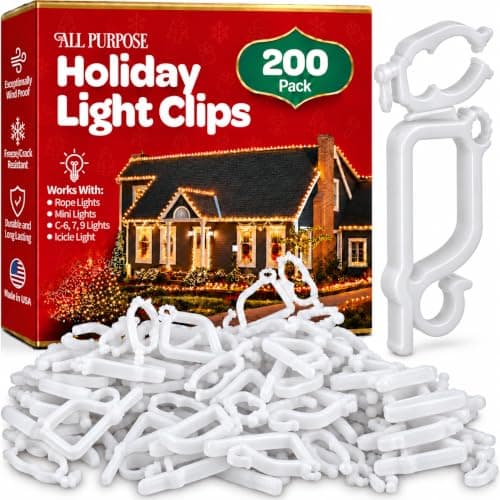 All-Purpose Holiday Light Clips, 200-packFits C7, C9, mini, icicle; 200-pack | One clip for a whole mixed display | 9.0 | $12.49 · View on Amazon |
#ad We may earn a commission · Price as of October 17, 2026
Scores are our own editorial judgment from published specifications and buyer feedback, scored against the same criteria across this category. See how we pick.
Jump to a full review below: lights
The short version: outline the door surround with 5 mm wide-angle LED minis at tight spacing, and put a wreath in the middle of the door. Our top pick is the Wintergreen 5 mm wide-angle set, because at close viewing distance you want many small points of light rather than a few large bulbs, and the wide-angle lens throws sideways along a flat trim board instead of straight out at the person standing on the mat. If you would rather not fix anything to the trim at all, a pre-lit battery garland arched over the header is the no-tools version and it has daylight presence as well.
Viewing distance is the whole brief
Everything else on a house is lit to be read from the curb. A front door is lit to be read from the path, the porch and the doormat — six to fifteen feet. At that range a C9 bulb is a glare source rather than a decoration, and the gaps between bulbs become the thing you notice.
The published spacing guidance follows from that. Six inches is the stated maximum for house trim; four inches is the figure for poles and banisters; two and a half inches is what wreaths use. A door surround sits at the tight end of that range because of how close it is read. Use 4-inch spacing on a plain trim board and tighter if the trim is narrow.
| Treatment | What it needs | Reads best | Effort |
|---|---|---|---|
| Outline the surround trim | 2 x height + width of 5 mm mini, plus clips | From the path, at night | Medium |
| Garland arched over the header | One or two 9 ft pre-lit lengths | Day and night | Low |
| Wreath centered on the door | One 24-30 in wreath and a hook | Day and night | Lowest |
| All three together | All of the above | The full porch look | Highest |
Measuring the surround
The number you want is the outside perimeter of the trim, not the door. A standard 36-inch door in a frame with 4-inch casing has an opening about 44 inches wide and 86 inches tall, so the outline is two sides plus the header: roughly 216 inches, or 18 feet. A double door or a sidelight arrangement can easily double that.
- Measure the outside of the casing on both jambs and across the header. Ignore the door itself.
- Add ten percent for the two corners and the slack lost at each turn — the same allowance professional installers use on every segment of a house.
- Divide by your spacing to get the bulb count. 18 feet at 4-inch spacing is 54 bulbs, so one 70-bulb, 24-foot set covers a single door with a little to spare.
- Decide where the run starts and ends, because that is where the cord or battery box has to live. The bottom of one jamb, close to the ground and behind a planter, is the usual answer.
Attachment, by what the trim is made of
A door surround is wood, composite, vinyl-wrapped or masonry, and none of them wants a nail in December. Three options cover it.
- All-purpose light clips that take mini, icicle, C7 or C9 and grip a trim edge or a shingle line. The cheapest reliable method, and they come in 100 to 600 packs so the per-clip cost is nothing. Count one clip per bulb interval rather than one per corner, or the run will sag between supports.
- Outdoor-rated adhesive hooks on a clean, dry painted surface, applied before the weather turns cold. They are the right answer on a smooth painted casing and the wrong one on cold, damp or textured trim.
- Cup hooks, once, if you light the door every year. A permanent small hook at each corner turns next year's install into a ten-minute job. It is a hole, so it is a decision, but it is one hole instead of a strip of adhesive residue.
- Masonry-rated adhesive or mortar-joint clips on a brick or stone surround. Brick and stucco mounting covers both.
The garland-arch alternative
If you do not want to attach anything to the trim, arch pre-lit garland over the header instead and let it do all the work. The advantage is that garland is present in daylight as well as at night, which a light string is not, and the whole thing hangs from two hooks.
Battery garland is the cleanest version because there is no cord to route down a jamb. National Tree's 9-foot Carolina Pine garland publishes 240 tips and 100 warm white LEDs on three D cells, with a built-in timer that runs 6 hours on and 18 hours off at the same time every day — set it once in November and do not touch it again. One 9-foot length covers a standard header with a drop at each side; a wide surround or a double door takes two.
The wreath, sized properly
A wreath is the highest-impact, lowest-effort item on a doorway, and the usual error is buying one size too small. On a standard 36-inch door a 24-inch wreath is the conventional fit and a 30-inch wreath reads generously. Go larger than that and it starts to look like a garage wreath on a front door.
If the door is exposed rather than under a deep porch, buy a wreath specified for open weather. The commercial 30-inch pre-lit wreaths publish 240 crush-resistant tips, 100 wide-angle LEDs at 7 W, a galvanised steel frame specified against rust and sealed shatterproof acrylic bulbs — and a warranty stated on the basis of 90-day seasonal use, which tells you exactly how the manufacturer expects it to be used. Best outdoor Christmas wreaths covers the lit-versus-unlit and battery-versus-plug decisions.
How we picked
Published manufacturer specifications for bulb count, spacing, tip count, wattage and timer behavior, published professional guidance on front-door decorating and spacing, and published electrical-safety guidance for outdoor decorations. Every figure is linked below. See methodology.
The picks in full
Top pick
5 mm Wide Angle LED Mini Lights, 70 ct, green wire
Wintergreen Lighting
The commercial 5 mm wide-angle string is the format built for tree wrapping: a small concave lens that throws light sideways, on a green wire that disappears into bark and foliage in daylight.
Wrapping a tree is a different lighting problem from outlining a roof, and the bulb that solves it is different too. A roofline wants a big bulb that reads as a distinct point from the street. A trunk wants a small bulb, close together, that turns the bark into a glowing column — and that is what the 5 mm wide-angle format is for. Christmas Lights, Etc identifies 5 mm LED wide-angle lights as the type most commonly used on outdoor trees, and the reason is the lens: it is concave, so it spreads light sideways around the curve of the trunk instead of firing it into the street.
Wintergreen's 70-count set runs 24 feet on green wire. Green matters more than people expect. Lights are lit for roughly eight hours a night and the wire is visible for the other sixteen, and white wire spiraled up a dark trunk is a barber pole in daylight. Green disappears against bark and evergreen foliage; brown wire, sold in the same format, disappears against deciduous trunks.
The practical limit is length. Twenty-four feet sounds like a lot until you wrap it: at the 6-inch spiral spacing Christmas Lights, Etc recommends for the best look, a single set covers a surprisingly short stretch of a mature trunk. Buy by measured length rather than by set count, and buy connectable so the whole trunk runs off one feed.
What you give up against a socketed C9 is repairability — these are prelamped, so a failed section is a failed set. For a trunk wrap that is an acceptable trade, because the wire is doing structural work around a rough surface and the failure mode is usually abrasion rather than a dead bulb.
What works
- Wide-angle lens spreads light around the trunk rather than straight out
- Green wire is invisible against bark and foliage during the day
- Connectable, so a tall trunk is one continuous wrap from one outlet
- Small bulb means the wrap reads as a line of light, not a row of dots
What does not
- Bulbs are not individually replaceable on a prelamped set
- 24 ft per set covers less trunk than you expect once it is spiraled
- Manufacturer does not publish a rated-hours figure for this line
| Bulb | 5 mm wide angle (concave lens), LED |
|---|---|
| Set | 70 bulbs, 24 ft |
| Wire | Green (other colors sold in the same line) |
| Use | Commercial grade, outdoor |
| Connectable | Yes, end to end |
A door surround with no outlet near it
National Tree Company 9 ft Pre-Lit Carolina Pine Garland, warm white LED
National Tree Company
The densest pre-lit 9-footer we found with a built-in timer and no cord: 240 tips, 100 warm white LEDs, battery-run on a 6-on / 18-off cycle. A door frame is exactly where a trailing cord ruins the look.
A front door is the hardest place in an outdoor display to run power to, and it is the place where a visible cord does the most damage, because the garland is at eye level and eighteen inches from where people stand. That one fact decides this pick. National Tree's Carolina Pine garland is battery-run with the light string built in, so the only thing you are hiding is a battery box rather than a cord down the door frame.
The specification that makes it worth the money over a cheaper pre-lit garland is tip count. National Tree publishes 240 PVC tips on this 9-foot length, in a mix of bristle and cashmere needle shapes. Tip count is to garland what branch-tip count is to an artificial tree: it is the number that predicts whether the thing reads as greenery from ten feet away or as a wire with needles attached. A 9-foot garland at 160 tips looks sparse on a door frame in daylight, and a door frame is seen in daylight far more than it is seen lit.
The lights are 100 warm white LEDs and they stay lit if a bulb fails, which matters more on garland than on a roofline run — a dead section in the middle of a door surround is impossible to ignore and awkward to reach into. The built-in timer runs a fixed 6 hours on, 18 hours off cycle that restarts at the same time each day. It is not a clock you set, but it does mean the garland comes on by itself every evening, which is the difference between a decoration that works all season and one that gets switched on four times in December.
Two honest limits. Batteries are a running cost, and cold reduces usable capacity, so a hard December will shorten the per-set runtime — budget for a mid-season change of the three D cells rather than being surprised by it. And National Tree's own wording for this range is indoor and covered outdoor spaces, which is the real constraint on nearly every pre-lit garland sold and the reason this page has a separate pick for fully exposed runs.
Length, width, tip count, light count, power, timer behavior and the covered-outdoor rating above are National Tree Company's published figures, linked in the sources below.
What works
- No cord, which is the whole problem with lighting a door frame
- A real timer on board — no outdoor timer, no smart plug, nothing to remember
- 240 tips is dense for a 9 ft garland and it is what makes it read as greenery, not wire
- LED draw means D cells last a season rather than a fortnight
What does not
- Batteries are a consumable and cold shortens them — plan on a mid-season change
- The timer is a fixed 6/18 cycle, not a clock you set
- National Tree rates it for covered outdoor, not a fully exposed railing
- 3 D cells sit in a visible battery box you have to hide in the greenery
| Length | 9 ft (108 in) |
|---|---|
| Width / depth | 10 in x 10 in |
| Branch tips | 240 PVC tips, mixed bristle and cashmere |
| Lights | 100 warm white LED, stay-lit if a bulb goes out |
| Power | Battery — 3 D cells, not included |
| Timer | Built in: 6 hours on, 18 hours off, same time daily |
| Trim | Pine cones |
| Rated for | Indoor and covered outdoor spaces (manufacturer wording) |
A wreath that sits in open weather
Red Sleigh 30 in Sequoia Fir Commercial-Grade Pre-Lit Wreath, 100 warm white LED
Red Sleigh
The only kind of pre-lit wreath actually built for an exposed wall: a galvanized steel frame, sealed shatterproof bulbs and a published outdoor rating instead of the covered-outdoor wording every retail wreath carries.
Read the fine print on nearly any pre-lit wreath sold at retail and you will find the same line: for indoor or covered outdoor use. That is an accurate description, not a disclaimer. A seasonal wreath is a wire ring, PVC needles and a light string that was never specified to sit in freezing rain with nothing above it.
Commercial Sequoia Fir greenery is the category that was. The published specification for this line is a heavy-duty galvanized steel frame specifically to prevent rust, thick crush-resistant PVC needles, UV-resistant construction, and shatterproof acrylic bulbs sealed to keep water out. The 30-inch carries 100 warm-white wide-angle LED mini lights across 240 tips, weighs 8 lb, has a 13-inch inner diameter and draws a published 7 watts. It is sold under the Red Sleigh label on Amazon and as Wintergreen Lighting through commercial suppliers.
Two of those details are worth translating. Wide-angle LED is the 5 mm lens style that throws light sideways rather than straight out of the bulb tip, which is why a commercial wreath reads as lit greenery from the curb instead of as a ring of bright dots. And galvanized steel is the answer to the specific way cheap wreaths die: the frame rusts where the needles trap moisture, the ring loses its shape, and by season three it hangs lopsided no matter how you dress it.
The warranty is the clearest signal of the difference. The line publishes ten years on the greenery and three years on the lights, based on ninety days of seasonal use per year. No retail wreath publishes anything comparable, because no retail wreath is expected to last that way.
What you give up is decoration and price. This is plain lit greenery — no pine cones, no berries, no bow, no glitter. If you want the dressed look you are adding it yourself and storing it yourself, and a weatherproof bow is its own small purchase. And it costs several times what a decorated 24-inch retail wreath costs, which is the honest reason most people do not buy one.
Size is the last check. Thirty inches is a wreath for a wall, a gable, a garage front or a double door. On a standard 36-inch single front door it will look oversized and will foul a storm door. The 24-inch pick further down this page exists for exactly that reason.
The frame material, tip count, light count, bulb construction, inner diameter, weight, wattage, outdoor rating and warranty terms above are the published figures for the commercial Sequoia Fir wreath line, linked in the sources.
What works
- Published for outdoor use, not the covered-outdoor wording on retail wreaths
- Galvanized steel frame instead of a wire ring that rusts and loses its shape
- Sealed shatterproof bulbs, so the lights are not the part that ends the wreath
- 7 W means a facade of these is still nothing on a 15-amp circuit
What does not
- Costs several times what a decorated retail wreath costs
- Plug-in only — there is no battery version, so it needs a cord run
- Plain lit greenery: no cones, berries, bow or glitter unless you add them
- A 30 in wreath is too big for many standard front doors; measure first
| Diameter | 30 in, 13 in inner diameter |
|---|---|
| Lights | 100 warm white wide-angle LED mini lights |
| Tips | 240, thick crush-resistant PVC |
| Power | 7 W per wreath (published figure) |
| Frame | Heavy-duty galvanized steel, specified to prevent rust |
| Bulbs | Shatterproof acrylic, sealed to keep water out |
| Weight | 8 lb |
| Rating | Rated for outdoor and indoor use; UV resistant |
| Warranty | 10 years greenery / 3 years lights, based on 90-day seasonal use |
Wreaths, garland and anything on a door
Twinkle Star Battery Operated String Lights, 16 ft / 50 LED, 2-pack
Twinkle Star
Battery sets exist for the places a cord cannot go without looking terrible — a door wreath, a mailbox, a porch column. Judged on that job they are excellent; judged as house lighting they are not.
A cord running down the front door frame ruins a wreath. That is the entire case for battery lights, and it is a good one.
This set is 16 feet with 50 warm white LEDs, sold in twos — which is the right quantity, because the places battery lights belong come in pairs: a wreath and a mailbox, two porch columns, two window boxes. If the set you buy has a built-in timer, use it; without one you are opening the door and fishing behind the greenery every evening, and nobody does that past about day four.
The thing nobody mentions in listings: alkaline batteries lose capacity in the cold, and a wreath on an exterior door is at outdoor temperature. Expect noticeably shorter runtime in a cold snap than in a mild week. Lithium AA cells hold up much better in cold and are worth the premium on anything you do not want to service in January.
Hide the battery box in the back of the wreath before you hang it, not after. This sounds obvious and it is the step everyone skips.
What works
- No cord down the door frame — the whole point
- Two sets in the pack, which is the number a door and a mailbox actually need
- Trivially movable
What does not
- Cold weather cuts alkaline battery capacity significantly
- The battery box has to be hidden, and on a wreath that is fiddly
- Replacing batteries mid-season on a door wreath is a real chore
| Length | 16 ft per set |
|---|---|
| LEDs | 50, warm white |
| Pack | 2 |
| Power | Battery (cells typically not included) |
| Use | Outdoor rated; the battery box is the weak point |
| Runtime | Varies with mode and temperature |
One clip for a whole mixed display
All-Purpose Holiday Light Clips, 200-pack
All-Purpose Holiday Light Clips
The all-application shape holds C7, C9, mini and icicle strings and mounts to either a gutter lip or under a shingle. If you are buying one clip type for the whole house, this is it.
The clip aisle is confusing because clips are sold by the problem they solve rather than by a spec, and the problems overlap. The all-application shape is the answer to that: a body that hooks over a gutter lip or slides under a shingle, with a gripper that takes a C7 or C9 bulb base as well as a plain wire.
For most houses that is one purchase instead of three. A typical display runs C9 along the gutter, mini string around a porch column and icicles over the garage — three bulb types that would otherwise mean three clip types.
The compromise is real but small. A dedicated C9 gutter clip holds a bulb more rigidly upright than a universal one does, so on a long exposed gutter in wind you will see a bit more bulb rotation. On a typical residential run at typical wind speeds, this is a cosmetic difference.
Count generously. The convention is a clip every 12 inches for bulbs and every 18 to 24 inches for plain wire, which means a 180-foot roofline is about 180 clips for C9. Buy 250. Clips are cheap, a second trip is not, and you will lose some into the gutter.
One thing no clip does: work on a gutter with a solid-top gutter guard. That is a separate problem with a separate answer, and we link it from here because it catches people out every year.
What works
- One item covers gutters, shingles and every common bulb type
- No tools, no adhesive, nothing that stays behind in January
- Cheap enough that over-buying is the correct strategy
What does not
- A do-everything shape holds a C9 slightly less rigidly than a dedicated C9 gutter clip
- Does not solve gutter guards — nothing that grips the lip does
| Fits bulbs | C7, C9, mini, icicle |
|---|---|
| Mounts to | Gutter lip or under shingle |
| Pack | 200 (100, 400 and 600 also sold) |
| Material | Plastic |
| Tools | None |
Common questions
What are the best Christmas lights for a front door frame?
5 mm wide-angle LED mini lights at about 4-inch spacing, run around the outside of the casing. A doorway is read from six to fifteen feet rather than from the street, so you want many small points of light rather than a few large bulbs, and the wide-angle lens throws sideways along flat trim instead of straight at the person on the mat.
How many lights do I need to outline a front door?
Measure the outside of the casing — both jambs plus the header — and add ten percent for the corners. A standard 36-inch door in 4-inch casing is roughly 18 feet of outline, which at 4-inch spacing is about 54 bulbs. One 70-bulb, 24-foot 5 mm set covers a single door with a little to spare.
How do you power lights around a door with no outlet nearby?
Battery, or a porch receptacle at one side of the door. Never run a cord across the threshold, under the door or pinched in the door itself: a cord in a doorway cannot shed heat and is a recognised fire hazard that electrical-safety guidance names specifically.
What size wreath fits a front door?
On a standard 36-inch door, 24 inches is the conventional fit and 30 inches reads generously. If the door is not under a deep porch, buy one specified for open weather — the commercial 30-inch pre-lit wreaths publish a galvanised steel frame specified against rust and sealed shatterproof bulbs, with a warranty based on 90-day seasonal use.
Is garland better than lights around a door?
It is better at one thing: daylight. A light string disappears during the day and garland does not, and arching one 9-foot pre-lit length over the header hangs from two hooks with nothing fixed to the trim. Battery garland avoids the cord entirely — National Tree's publishes 100 warm white LEDs on three D cells with a 6-on/18-off timer.
Sources
Every specification quoted on this page comes from the manufacturer’s own published information or a current retail listing, linked below. Where a figure is not published, we say so rather than estimating it.
- Christmas Designers — how to decorate a front door for Christmas like a pro (surround outlining, garland arch over the header, wreath scale on an entry door)
- 1000Bulbs — Christmas mini lights buying guide (6 in maximum for house trim, 4 in for poles and banisters, 2.5 in for wreaths)
- The Christmas Light Emporium — how to hang Christmas lights, complete method (measure each segment, add ten percent, space clips at the bulb interval)
- Wintergreen Lighting — 5 mm wide angle LED mini light specifications
- National Tree Company — 9 ft pre-lit Carolina Pine garland (240 tips, 100 warm white LED, 3 x D cells, 6 hours on / 18 hours off timer)
- Christmas Lights Etc — Red Sleigh 30 in Sequoia Fir commercial pre-lit wreath (240 crush-resistant tips, 100 wide-angle LED, 7 W, galvanised steel frame, warranty stated on 90-day seasonal use)
- ESFI — outdoor decoration safety tips (do not run extension cords through doorways, GFCI protection, keep connections out of standing water)
- Christmas Lights Etc — Christmas light clips guide (clip types by mounting surface, all-purpose clips for mini, icicle, C7 and C9)